Mercedes Presents Details Of Their Forward-Looking Safety Concepts
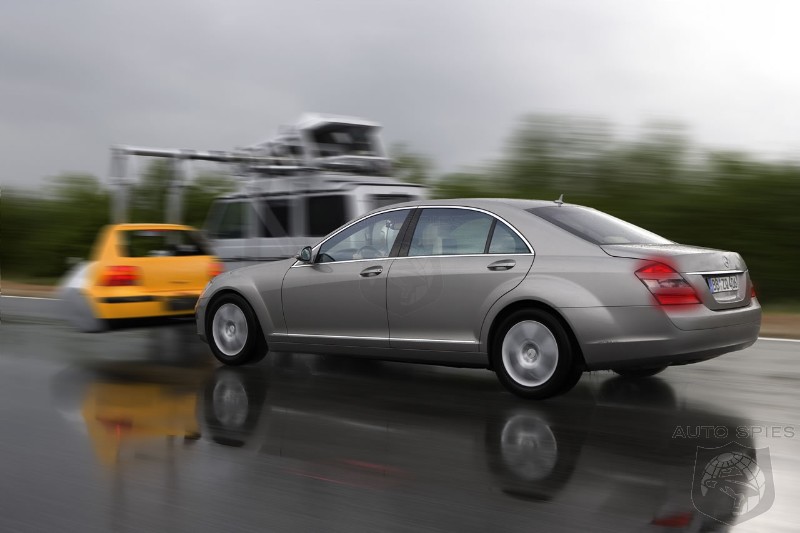
Safety Trendsetter Mercedes-Benz Takes a Look into the Future: From a Vehicle with “Reflexes” to a “Thinking Partner”
Friedrichshafen, Jun 15, 2007
Mercedes-Benz is laying the groundwork for a new, forward-looking safety concept. Following its impressive success in the area of occupant protection, the Stuttgart-based brand will focus more strongly in the future on anticipatory recognition and the prevention of accidents. To this end, Mercedes-Benz is developing intelligent driver assistance systems that utilize stereo cameras and radar sensors to monitor the area surrounding the vehicle. These systems also have the ability to make predictive interpretations of critical driving situations and then issue timely warnings to drivers - or even intervene autonomously if there is imminent danger. “Several years ago, we introduced PRE-SAFE®, which gave the vehicle certain ‘reflexes,’ so to speak,” says Dr. Thomas Weber, DaimlerChrysler Board of Management member responsible for Group Research and Mercedes Car Group Development. “In the future, we will also give cars the ability to ‘see’ and ‘think.’ It’s always been a matter of policy for us to develop vehicles capable of withstanding the most severe crash tests. However, it makes much more sense to prevent accidents from occurring in the first place - which is exactly what we’re working on in the interest of all traffic participants.”
In the future, Mercedes-Benz will continue to base the development of its safety systems on real-life accident statistics and data from its own accident research activities. The focus here will be on intersections, sharp curves, and construction sites, as these locations are the site of approximately one-third of all serious accidents that occur in Germany. Other issues to be addressed in the development of new driver assistance systems include driver fatigue, speed, and lane departure, all of which are also among the most frequent causes of accidents. Mercedes-Benz will also further improve occupant protection through preventive measures and by networking active and passive safety systems.
Systems developed by Mercedes-Benz have been helping to improve road safety for many years now. The invention of ESP® alone (which reduces the danger of skidding and makes it easier for drivers to handle critical situations) has led to a sustained improvement in traffic safety. The most recent German accident statistics confirm that since ESP® was introduced as standard equipment, Mercedes passenger cars have been involved in accidents much less frequently than models of other brands. Since 1999, the share of driver-related collisions in all accidents involving newly registered Mercedes models has declined by more than 42 percent. Studies show that more than 20,000 accidents could be prevented each year in if all passenger cars were equipped with ESP®. The Electronic Stability Program has now therefore joined seatbelts, airbags, and ABS as one of the most important safety systems in modern passenger cars. Still, only around 40 percent of all new cars in are currently equipped with this technology.
The Brake Assist (BAS) system, which Mercedes-Benz began offering in 1996 (the world’s first brand to do so), has also proved to be a very effective technology for preventing accidents. Following the introduction of BAS as standard equipment, the share of total accidents accounted for by rear-end collisions fell by eight percent for Mercedes vehicles, but remained nearly unchanged for all other brands. Brake Assist also led to a 13 percent reduction in the proportion of serious accidents involving pedestrians.
PRE-SAFE® Brake proves itself as an “electronic crumple zone”
Mercedes-Benz will continue to base the development of its driver assistance systems on real-life accident statistics, and will utilize new technologies to focus more strongly on the phase immediately preceding an accident. The brand’s engineers are developing systems that monitor the area around the vehicle, warn drivers of potential dangers, and then support them if necessary. Such systems will also activate preventive occupant protection systems in critical situations.
The era of the “seeing” car began in 2005 with the introduction of Mercedes-Benz’ BRAKE ASSIST PLUS (BAS PLUS) system, which was followed by the PRE-SAFE® Brake in 2006. Both systems utilize radar sensors that measure the distance to the vehicle ahead, and are thus able to recognize an impending rear-end collision. BAS PLUS warns drivers of the danger and then immediately makes available the braking pressure required for the situation at hand. The PRE-SAFE® Brake intervenes if an accident is imminent by autonomously braking the vehicle if the driver has not reacted to the prior warning issued by the system. This autonomous partial braking maneuver significantly reduces the impact speed should a collision still occur, whereby the system acts as an “electronic crumple zone” that offers vehicle occupants additional protection. A test conducted by the German Automobile Club (ADAC) shows that the PRE-SAFE® Brake reduces the stresses vehicle occupants are exposed to in accidents by up to 45 percent.
Mercedes engineers are currently testing the second stage of the PRE-SAFE® Brake, which involves initiating an automatic emergency braking maneuver if a collision becomes unavoidable. This will lead to a further substantial reduction of impact energy.
Intersection assistant calculates danger of an accident in advance
Video-based assistance functions will also become more common in future Mercedes passenger cars. Here, cameras mounted on the inside of the windshield will monitor the road in front of the vehicle, recognize pedestrians and cyclists up ahead or crossing the street, and “read” traffic signs. Powerful computers will evaluate the images in realtime and warn drivers of impending dangers before they occur.
This technology is designed with a particularly accident-prone area in mind - the four-way intersection, which accounts for around one-third of all serious traffic accidents in Germany. A new system already developed by Mercedes as a prototype utilizes a stereo camera that recognizes cars, cyclists and pedestrians approaching the vehicle from the side. By monitoring the movement, distance, and speed of the object in question, the system is able to predict its probable direction of motion and calculate the likelihood of an accident in advance. Tests have shown that this forward-looking technology is able to recognize the danger of a collision with a cyclist rapidly approaching the vehicle from the side two to three seconds before impact. This allows the system to gain valuable time to warn the driver and prevent the accident.
Another video-based Mercedes assistance system will remind drivers in the future to obey speed limits by “reading” traffic signs and transmitting their images to a cockpit display in the vehicle. This technology will be used further down the line to also register stop signs, yield signs, and traffic lights.
Lane departure prevention assistant steers vehicle by means of targeted braking impulses
Approximately one out of every six major accidents in Germany occurs because a vehicle inadvertently moves out of the lane it’s traveling in. More than one-third of all traffic fatalities also result from such accidents. Mercedes-Benz is therefore developing a lane assistant that warns drivers when they inadvertently drift out of the lane they’re traveling in, and autonomously puts the vehicle back on course if an accident appears imminent.
The system uses a camera to detect lane markings, while simultaneously monitoring the vehicle’s movements within the lane, as well as the driver’s activities. In the system’s initial phase, vibrations in the steering wheel let drivers know that they have moved out of the lane and should take corrective action. Should the driver fail to react to this subtle but effective warning, the system will put the vehicle back on the proper course by initiating a targeted braking maneuver on one of the wheels.
This braking action automatically disengages if the driver begins steering back to the proper position.
Blind Spot Assist makes lane changes safer
Another newly developed Mercedes assistance system provides for even more safety when changing lanes. The system works with six close-proximity radar sensors that monitor the area behind both sides of the vehicle, thereby enabling them to register whether another vehicle is moving through the blind spot in an adjacent lane. If this is the case, the system will inform the driver by means of a red warning light in the side-mirror glass. The system will then sound an alarm if the driver fails to notice the warning and hits the blinker as a prelude to changing lanes.
Fatigue detection warns drivers of dangerous microsleep
Fatigue detection is the designation for a new field in which Mercedes safety engineers are continuing their practically focused development of systems for accident prevention. Various scientific studies estimate that between 10 and 20 percent of serious traffic accidents can be attributed to fatigue. According to an investigation carried out by insurance companies in Germany, fatigue is responsible for one in four fatal motorway accidents.
The goal of the Mercedes engineers is to develop an assistance system that can recognize fatigue before it becomes a danger, and then warn the driver. A team of Mercedes experts has therefore been studying various approaches for reliably recognizing early signs of driver fatigue. More than 250 drivers have participated in the associated tests, traveling around 400,000 kilometers in the process.
Radio system sends danger warnings from vehicle to vehicle
Mercedes-Benz expects road safety to also be enhanced even further in the future by car-to-car communication systems, which are now undergoing a major testing campaign in Germany. Mercedes is contributing its more than six years of practical experience in this area to the test series, which is being conducted jointly by several German automakers and industrial companies.
Car-to-car communication systems utilize WLAN (Wireless Local Area Network) radio technology, which enables them to rapidly transmit warnings in time to prevent accidents. Among other things, such systems can be used to warn drivers of fog, black ice, and other dangers right around the next bend. The vehicles serve as transmitters or receivers of information, which they can also forward to other vehicles like a relay runner passing a baton. The critical situations themselves are registered by existing onboard safety systems such as ABS and ESP®. In the future, it may also be possible to have vehicles communicate with roadside beacons in order to optimize traffic flows and prevent the formation of traffic jams.
Radar sensors analyze the size and weight of a potential accident partner
Car-to-car communication systems can improve occupant protection as well by exchanging data between vehicles when a collision has become unavoidable. Seatbelt tensioners, airbags and other safety features could then be adjusted in accordance with the data obtained on the counterpart vehicle, whereby at close ranges (immediately before an impending accident), the automobiles of tomorrow could exchange data on vehicle type, mass, rigidity or geometry. As a result, the activation of occupant protection systems could be tailored even more closely to the requirements of the circumstances.
Radar sensor systems that are already available in various Mercedes models could be utilized in the future for anticipatory crash analyses. Here, the system would “see,” for example, whether the vehicle approaching on a collision course is a truck, a bus or a car, allowing it to calculate the severity of the impending impact and the settings required for safety systems. Every fraction of a second before an accident counts when it comes to properly preparing vehicle occupants for an impending impact. Preemptive crash analysis therefore represents a crucial further step toward enhancing occupant safety - and an important supplement to the proven PRE-SAFE® system.
By working on these and other such innovations, Mercedes-Benz is continuing its long-term commitment to improving road safety. As ever, this approach is based on the prime principle of the Mercedes safety philosophy, as formulated by Béla Barényi: To make an important contribution to improving safety on our roads and, with each new invention, to move a little closer to the vision of accident-free driving.