Do You Agree? Study Indicates That Buying Small Cars Is Worse For The Planet
Do You Agree? Study Indicates That Buying Small Cars Is Worse For The Planet
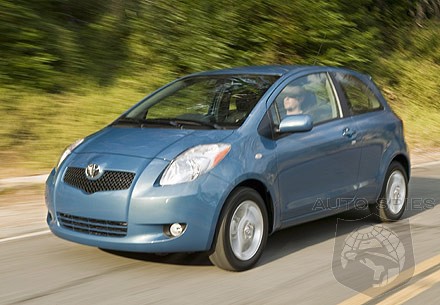
Here's a radical thought for the car-buying public. Small cars have no future. In fact, all those sub-compacts and compacts, the Hyundai Accents and the Mazda 3s, the Toyota Yarises — even the perennially popular Honda Civics — may soon be nothing but scrap.

In fact, by buying them instead of heavier, sturdier mid-size sedans or even pickup trucks, lots of well-meaning Canadians are just contributing to landfills. So says Richmond Hill, Ont., automotive analyst Dennis DesRosiers, whose most recent study on vehicle longevity tends to point out certain truisms consumers ignore.

Never mind the panic at the pumps, DesRosiers says, or the "misfocused" green movement. Small cars, even the most popular brands like Toyota, can be bad investments, both for the planet and the pocketbook.


Read Article

candywhitecandywhite - 10/3/2008 12:52:02 PM
+7 Boost
what a crock of shit.
this is the most biased "analysis" i have ever read. but then i only read the topic.


bigmotovbigmotov - 10/3/2008 1:13:38 PM
+7 Boost
Pathetic! Seems like anyone can make "studies" and "analysis" these days.


AgentOrangeAgentOrange - 10/3/2008 1:26:12 PM
+1 Boost
From crap to scrap? I don't think so...


pepito66pepito66 - 10/3/2008 2:16:51 PM
+3 Boost
I don't think small cars is worse for the planet and if yes why???
Car size and election of models from customer depend to their money to spend and how they use the car.


chewychewy - 10/3/2008 2:29:53 PM
+1 Boost
I think cars are the most recycled things on the planet. And you can drive a small car for a long time as well. A 10-15 year old compact and pickup will both likely be in poor shape, mostly depending on the miles.


topneurotopneuro - 10/3/2008 2:47:46 PM
+3 Boost
A pile of trash gets publish/printed, true for literature, politics, law, research, academic, science, newspapers, etc. Just read the Bailout Bill.
The internet is no exception, autopsies has it’s share.

Ouch …


daytonavioletdaytonaviolet - 10/3/2008 4:18:31 PM
+2 Boost
Apparently the author of this article has never heard of companies like Honda and Toyota.


bluedartbluedart - 10/3/2008 4:39:08 PM
+3 Boost
that's one study that comes right out of one's ass


makkystylemakkystyle - 10/3/2008 5:17:13 PM
+3 Boost
First, it wasn't a "study" 009, not trying to pick on you today, but really... step it up a notch.

Here was my "letter to the editor":

First, I must state that I recognize that Ms. Righton in her article references other sources for all of her data or opinion, but in a case where only one side of an argument is presented, the "journalist" is as much at fault as her sources for perpetuating the falsehoods.

I think Barbara Righton accurately depicts a problem with the North American auto purchasing consciousness in her article, but erroneously extrapolates reasons for certain trends without recognizing the true causes. The fact is this:

Traditionally, in North America small cars have not lasted because longevity is sacrificed for low-price. Think Pinto, Le Car, Colt, etc.

Unlike in Europe where it is commonplace to expect high-quality compacts from makers like Mercedes-Benz, Peugeot, Citroen, Alfa Romeo, Audi and even Ford. It is only in recent years that consumer tastes in North America have recognized that you don't have to sacrifice quality for compact size and consumers are now willing to pay for it. One need only look at the resale values (in North America) of the BMW made Mini Cooper to see that small cars can indeed maintain their value over the projected lifetime of the vehicle; and if Ms. Righton thinks the projected lifetime of one of these cars is less than a "heavier, sturdier mid-size sedans or even pickup truck" she would be absolutely wrong.

The problem is not the lifespan of lighter-weight vehicles as she suggests. In fact, elementary physics would tell us that less force is exerted on lower mass cars and therefore less stress and wear, suggesting they may actually last longer. The problem has been with consumer tastes in this part of the world. 15 years ago Mercedes-Benz, BMW, Audi would have never released a compact car in the US (and I'm assuming Canadian market). Today things have changed. These same manufacturers are now releasing smaller and smaller models and I'm sure, should Ms. Righton care to ask them, they would attest to the build quality and longevity of their vehicles.

It is asinine to compare the residual value of a car that costs US$12,120 (Aveo) with a car that costs US$22,275 (Malibu). Of course the Aveo is worth nothing in three years, it's called DEPRECIATION. It wasn't worth much to begin with.

A true litmus test might be to compare comparable vehicles if even only comparable in price. I would gladly put the physical longevity and long-term desirability of my $22,000 Honda Civic Si up against the Chevy Malibu. Honda Civics have one of the best resale values in their class and honda engines consistently run trouble-free for hundreds-of-thousands of miles... Chevy Malibu... not so much.

I hope you will print this as a counter to the one-sided point of view presented in the original article.


S4cabriofoxoneS4cabriofoxone - 10/3/2008 11:34:48 PM
+2 Boost
Great letter.


E36erE36er - 10/4/2008 1:42:01 AM
+1 Boost
Great letter overall. The Mini retains it's value because Mini does not discount below the sticker price.


sectorsector - 10/3/2008 6:04:29 PM
-1 Boost
Eating lots of fat helps you lose weight! Eat all the bacon, eggs, cheeseburgers, and lobster you want! fat doesn't make you fat, carbs make you fat!

believe me? I can back it up with studies :)


supermotosupermoto - 10/3/2008 6:46:15 PM
+1 Boost
It takes more energy to manufacture an entirely new car than what I would save vs. using my current car. Duh.


Copyright 2026 AutoSpies.com, LLC