Gas Sipper Shootout: 2009 Jetta TDI vs 2010 Honda Insight Which Saves More?
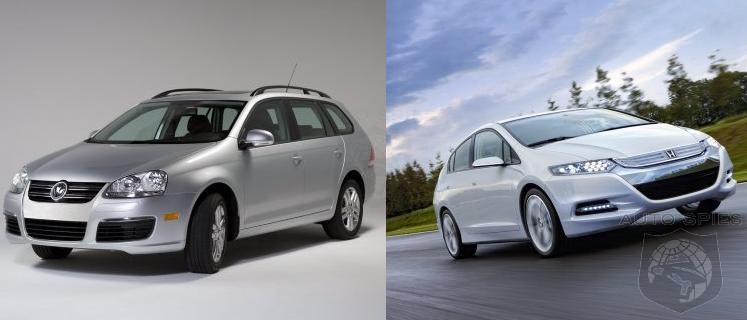
Gas Sipper Shootout: 2009 Jetta TDI vs 2010 Honda Insight Which Saves More?

So which is easier on your wallet: diesel or gasoline-electric hybrid?

I've run the numbers and, as it turns out, it's a wash.

The 2009 Volkswagen Jetta TDI will cost you 40 cents a kilometre to drive for the first four years, or $7,989.55 a year.

The 2010 Honda Insight will run you about 42 cents a kilometre. That number is an estimate, though a good one. Honda Canada won't announce the actual price until closer to launch date in April. But at about $20,000, Honda's newest hybrid will run you $8,327.75 a year.

The small annual difference in ownership costs between the two fuel-sippers really boils down to one thing: the price of money.

Don't forget the ability to upload your photos on the go, simply e-mail Mobile@AutoSpies.com

Also, don't miss out on our exciting galleries including the 2009 Geneva Auto Show as well as the Audi A5/A5 Cabriolet Gallery - NO ONE covers the shows like AutoSpies.com!


Read Article

_43LE_43LE - 3/17/2009 3:36:23 PM
-2 Boost
Well, it's not like the Corolla-inspired Jetta is very good looking either.


StarStar - 3/17/2009 1:46:37 PM
+4 Boost
I'll take the drivers car between the two...the TDI.


_43LE_43LE - 3/17/2009 3:34:30 PM
-4 Boost
Me too.


monkeyrunmonkeyrun - 3/17/2009 2:15:05 PM
+7 Boost
as of today. TDI's a better deal.

Did they eliminate some tax on Diesel recently?


RaulTRaulT - 3/17/2009 2:31:50 PM
+4 Boost
hybrid more reliable that diesel huh?

wow


FanboysStinkFanboysStink - 3/17/2009 3:05:32 PM
0 Boost
Hybrids are by a mile more reliable than modern diesels because they are... simpler. Much simpler.

Let's do a side by side comparison:

#1 TDI needs an ultra high pressure fuel pump delivering ~1800 bars and very fragile (to fuel quality) injectors with super tiny nozzles in them to ensure proper atomization.

Hybrids needs simple and reliable port injection. Little atomization is necessary due to fuel vaporizing when mixed with air.


#2 TDI needs complex double mass flywheel (with rubber elements and springs) to ensure engine operation smoothness.

Hybrids need simple solid flywheel than can't go wrong cause there is nothing to go wrong in it, its just a solid disc.


#3 TDI needs a variable vane turbocharger to extend lean burn mode. Turbochargers due to high rotational speeds never live as long as engine does. VTG ones increase risk of vane adjusting mechanism failure.

Hybrids replace this by introducing Atkinson cycle. It requires just different fixes valve timing. Nothing else. Swap the camshafts and you're done.


#4 TDI needs... a clutch. Which is a wear and tear item, can go wrong as every mechanical component in the car as well.

Prius has NO CLUTCH. Nothing to wear, nothing to worry about. Engine is directly connected to the transmission.


#5 Every Prius is automatic so we need an automatic TDI to compare. So the DSG one. It's a massively complex system. Not only it requires TWO clutches (instead of zero) but these needs hydraulic actuators. Then you have a six speed gearbox with lots of hydraulic/electric actuators to change gears for you.

Prius meanwhile has the SIMPLEST gearbox in the world. It's just... one set of gears. Combination of electric motors allows torque blending feature what works out as a classic gearbox, only way, way simpler.


#6 TDI needs, except ordinary catalyst, two additional exhaust treatment systems to meet criteria: a particulate filter and NOx trap with sensors to allow afterburning. Despite all this, it's still dirtier than Prius.

Prius needs just one single catalyst to treat exhaust fumes as good as it gets because it burns cleanly. It topped EIGHT HUNDRED cars in ADAC EcoTest (yes, it's a German institution).


So where do the hybrids have any disadvantage? Well, they need two electric motors more, a battery and a inverter. Problem is, a battery and an inverter have no moving parts so they very rarely break down (in the same way a CPU in your notebook rarely breaks down). And electric motors are one of the most durable means of propulsion ever invented by man.


Results are immediate:

Reliability rating:
Toyota Prius, award recipient, among the bests (yeah, "complex" hybrid tops the show) [...] long queue of cars [...] Volkswagen Jetta, lowest score.

And this is simple petrol version! Jetta diesel is way, way more complex, as proven above.

Source: http://www.jdpower.com/autos/ratings/dependability-ratings-by-category/compact-car/sortcolumn-1/ascending


IamEvilHomerIamEvilHomer - 3/18/2009 2:30:03 AM
+4 Boost
say what you want but the average life a a TDI is 2.5 of that of the gas versions. Don't see many gas engines with 300k but you see it in diesels all the time


XYZZXYZZ - 3/19/2009 4:03:21 AM
+1 Boost
say what you want, but the average trouble free life of ALL vws is 1/8 or less of the average Prius.

new issue of CR shows SCADS of 'black dots' (WORSE than average reliability) starting from just 2 years of age.

the ONLY black dots for Prii show up at year 5 (just for audio system) and year 6 (electrical; NOT motor or tranny).


NorthernlivingNorthernliving - 6/28/2009 10:01:28 PM
+1 Boost
You are on drugs. Diesels are SIMPLE - I've owned a ton of them. No ignition, no expensive batteries, and automatic or standard. Get your facts right before spewing misinformation. I've owned BOTH and will never get a battery operated car again! Have you replaced your batteries yet?


FanboysStinkFanboysStink - 3/17/2009 4:39:50 PM
+1 Boost
Globe Auto presented false calculation of hybrid vs diesel fuel costs.

Calculations are presented on this page:
http://www.theglobeandmail.com/servlet/story/RTGAM.20090115.whFaceoff0115/BNStory/specialGlobeAuto/?pageRequested=2

Here is the direct link:
http://images.theglobeandmail.com/archives/RTGAM/images/20090115/whFaceoff0115/15c_faceoff400big.jpg

We read that costs in $/km for the Insight and the Jetta are equal: 0,05 $/km.

Below we read annual cost of fuel for the Insight is $933 while for the Jetta TDI is $1064.

Calculation for the Insight is erroneous.

Assumptions in the article:
- both cars do 20.000 km annualy
- 55% city driving, 45% highway driving
- Insight consumes 4.8 l/100km city, 4.5 l/100km hwy
- Jetta TDI consumes 6.8 l/100km city, 4.8 l/100km hwy
- regular gas is $0.789/litre, diesel is $0.902/litre

Let's recalculate:

Honda Insight:
(20000*0.55/100*4.8 + 20000*0.45/100*4.5)*0.789=(528+405)*0.789~=$736

VW Jetta TDI
(20000*0.55/100*6.8 + 20000*0.45/100*4.8)*0.902=(748+432)*0.902~=$1064


thetruth01thetruth01 - 3/17/2009 5:09:33 PM
+2 Boost
Furthermore, the costs of ownership are weighted heavily against the Inisght due to financing costs and depreciation. Depreciation can hardly be guessed on a car that is not even for sale yet. And financing costs? Are they really saying that to own a car that costs $25000 (the Jetta), you will only pay $24000 over the loan? How much more upfront did the Jetta cost? There's something fishy here. More bogus journalism trying to drum up support for diesels. Of course Germanspies runs it.


zorbeezezorbeeze - 3/17/2009 6:31:42 PM
+1 Boost
Neither, but if i had to choose i would take the Insight. I would fall asleep behind the wheel of the Jetta, and add the fact that it is the ugliest car since the Asstek.


FanboysStinkFanboysStink - 3/17/2009 10:46:15 PM
+1 Boost
+1 juu76

Hybrids are simply the future of motoring.

Now electric propulsion is only used to recover energy of braking. Soon battery capacities will be extended and cars will start traveling more and more all electric miles, still having huge range when needed coming from a small ICE range extender.

Internal combustion will be gradually less and less relevant.


RonHc213RonHc213 - 3/18/2009 3:46:16 AM
+1 Boost
Now if only Honda would make a clean burning diesel for the North American Market.


t_bonet_bone - 3/18/2009 9:40:15 AM
+2 Boost
Why can't we just have diesel hybrids and be done with it?


AlexTxAlexTx - 3/18/2009 4:50:52 PM
+1 Boost
Oh yeah.. like the batteries in the Prius are soooo environmently friendly...
The TDi emits less CO2 than the outgoing Prius.
The only reason there are no Diesel Hybrid for now is not because of reliability (Ignorant David), it is because it is too $$$ to build.
This would just kill any regular hybrid.

In any case, I do think that Hybrids will have a short life once Hydrogen is developped.

I'll take the TDi thank you very much; it is fun to drive, I can still modify the hell of it and still return excellent mileage.
Just look at the VW TDI race series..
1 fill up lasts almost 2 races!!!!!!
Ever seen a race with Prius??
Enough said.


XYZZXYZZ - 3/19/2009 3:55:15 AM
+1 Boost
"In any case, I do think that Hybrids will have a short life once Hydrogen is developped." --ignorant AlexTx


hydrogen is pure pie in the sky. it is NOT an energy source, only a means of storing and TRANSFERRING energy from one source to another, not unlike a battery. and it is FAR LESS EFFICIENT than any battery.

do a little research before calling INTELLIGENT posters like david ignorant.


valhallakeyvalhallakey - 3/19/2009 2:01:36 AM
+1 Boost
Thier was an interesting article by some Canadian group comparing dust to dust impacts of various cars (I think... google it) that compared the overall environmental impact including all the manufacturing impact. In that study up to about 150k miles the Hummer was more environmentally friendly. They strip mine up in Canada for the Nickel used in the battery (yes pollution is better there now but is still outrageous), it is then shipped then to Ireland I believe where the battery was actually constructed, then shipped to Japan for the construction of the car itself. So if you keep your Prius for over 150k miles you will be better on the environment than the person who bought a Hummer. On the other hand if you bought say a.... Jetta... that mileage figure might just go up a bit! I admit there may be some controversy to this study (of course Toyota is going to fight that image)... but it does us all good to understand the whole picture!


XYZZXYZZ - 3/19/2009 3:43:32 AM
+1 Boost
"...article by some Canadian group comparing dust to dust impacts of various cars (I think... google it) that compared the overall environmental impact including all the manufacturing impact. In that study up to about 150k miles the Hummer was more environmentally friendly..."

LMAO!!!

that article was done by some kid TRYING to be a journalist! his "data" was outdated and distorted. the article got publicity beyond his campus ONLY because its claims were so outrageous and oft repeated.

eventually, the writer himself retracted his absurd claims.


valhallakeyvalhallakey - 3/20/2009 1:40:40 AM
+1 Boost
I admitted there was controversy associated with the study but many of the points made were valid ... you have to look at the entire building process... I have not seen any retraction although I have read some reports critical of the assumptions etc... made like this one http://www.pacinst.org/topics/integrity_of_science/case_studies/hummer_vs_prius.pdf
and you can certainly read the original report here
http://cnwmr.com/nss-folder/automotiveenergy/
My point in the end was if you compared the entire ecological damage of a Prius to something like the Jetta the results may have been more interesting even taking into account the faulty assumptions. So don't take LMAO-XYZZs word for anything go read up on it yourself.


XYZZXYZZ - 3/21/2009 5:23:07 PM
+1 Boost
yes, faulty assumptions, from the very site you cite led to this:

"Conclusion

"This short review and analysis calls into question the unsubstantiated conclusions of the CNW
“Dust to Dust” report – it appears that the report suffers from fatal flaws. Indeed, correcting only a few of these flaws
COMPLETELY changes the conclusions." [emphasis added]


XYZZXYZZ - 3/21/2009 5:27:24 PM
+1 Boost
just ONE of the totally biased, faulty assumption:

"The report’s major indicator is total energy use per mile traveled, which is calculated by dividing the energy cost by the lifetime mileage. The most obvious manipulation of data is the company’s
choice of total vehicle lifetime miles for each vehicle. For reasons not explained in the report, the
Hummer H3 is assumed to travel 207,000 miles in its lifetime. Even more remarkable, the
Hummer H1 is assumed to travel 379,000 lifetime miles. The Prius is assumed to travel only
109,000 miles.8
After readers of “Dust to Dust” questioned Prius’s assumed lifetime miles, CNW provided a note
revealing that they had assumed early Priuses traveled only 6,700 miles per year, which
translates into the low lifetime mileage assumption used in the study.9"

[8,9 being just a few of many footnotes]

incidentally, most toyota products are just BARELY BROKEN IN at 109,000 miles. not uncommon for them to rack up 200-300,000 miles.


XYZZXYZZ - 3/21/2009 5:29:19 PM
+1 Boost
and rare is the gm product that makes even 200k (say nothing of 370k) without an overhaul or two, or new tranny.


dieselboydieselboy - 3/25/2009 8:28:26 PM
+1 Boost
Mining of nickel can be environmentally destructive. Toyota buys nickel for Prius batteries from a mine in Sudbury, Ontario, Canada. The mine has created such a dead zone around it, that NASA now uses the area to test lunar rovers.

“The acid rain around Sudbury has destroyed all the plants and the soil slid off the hillside,” David Martin, a Canadian Greenpeace coordinator, told the British newspaper Mail.

Hope you hybrid freaks are happy, destroying forrest just to drive that ugly car


dieselboydieselboy - 3/25/2009 8:48:58 PM
+1 Boost
Building a Toyota Prius causes more environmental damage than a Hummer that is on the road for three times longer than a Prius. As already noted, the Prius is partly driven by a battery which contains nickel. The nickel is mined and smelted at a plant in Sudbury, Ontario. This plant has caused so much environmental damage to the surrounding environment that NASA has used the ‘dead zone’ around the plant to test moon rovers. The area around the plant is devoid of any life for miles.

The plant is the source of all the nickel found in a Prius’ battery and Toyota purchases 1,000 tons annually. Dubbed the Superstack, the plague-factory has spread sulfur dioxide across northern Ontario, becoming every environmentalist’s nightmare.

“The acid rain around Sudbury was so bad it destroyed all the plants and the soil slid down off the hillside,” said Canadian Greenpeace energy-coordinator David Martin during an interview with Mail, a British-based newspaper.

All of this would be bad enough in and of itself; however, the journey to make a hybrid doesn’t end there. The nickel produced by this disastrous plant is shipped via massive container ship to the largest nickel refinery in Europe. From there, the nickel hops over to China to produce ‘nickel foam.’ From there, it goes to Japan. Finally, the completed batteries are shipped to the United States, finalizing the around-the-world trip required to produce a single Prius battery. Are these not sounding less and less like environmentally sound cars and more like a farce?

Wait, I haven’t even got to the best part yet.

When you pool together all the combined energy it takes to drive and build a Toyota Prius, the flagship car of energy fanatics, it takes almost 50 percent more energy than a Hummer - the Prius’s arch nemesis.

Through a study by CNW Marketing called “Dust to Dust,” the total combined energy is taken from all the electrical, fuel, transportation, materials (metal, plastic, etc) and hundreds of other factors over the expected lifetime of a vehicle. The Prius costs an average of $3.25 per mile driven over a lifetime of 100,000 miles - the expected lifespan of the Hybrid.

The Hummer, on the other hand, costs a more fiscal $1.95 per mile to put on the road over an expected lifetime of 300,000 miles. That means the Hummer will last three times longer than a Prius and use less combined energy doing it.


Copyright 2026 AutoSpies.com, LLC