Hydraulic Launch Assist
Hydraulic Launch Assist
Well, as a final article (I'm going back to school next week and won't have any more time) I thought I'd write an article of something that I always wanted to try.

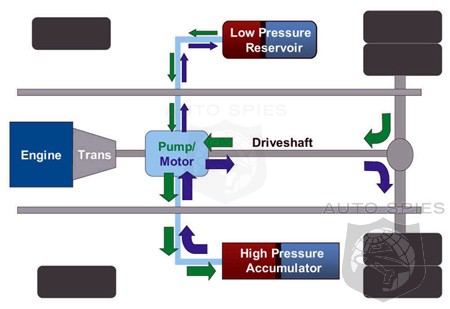
Hydraulic launch assist is a form of KERS. Except instead of using a flywheel or batteries/electric motors. You use hydraulics and nitrogen cylinders.

The concept works like this.

1. When you step on the brakes, a hydraulic pump engages.
2. The hydraulic fluid that the pump moves compresses a nitrogen spring (a nitrogen spring is basically a cylinder with one side filled with nitrogen, when it is compressed it stores energy by compressing the nitrogen)
3. When you step on the gas, the hydraulic pump is allowed to operate in reverse driving the wheels as nitrogen spring decompresses.

According to Ford's studies this mechanical method of recovering braking energy is about 60% efficient (in their test rig, who knows how efficient it could get after years of research). This compares to conventional electric hybrids which are maxing out at about 30% efficiency. Efficiency being measured where if you are going 100mph, hit the brakes and hit the gas you'd be able to get back up to 60mph with this system, or 30mph with the conventional hybrid system.

I guess now you are probably wondering why they don't use this system of cheap pumps and hydraulic lines instead of expensive batteries and motors. Well, it's because hydraulic launch assist is power dense where electric hybrids are energy dense.

Lets explain that concept. In a power dense system you are able to extract large amounts of energy at a very fast rate. In an energy dense system you are able to store large amounts of energy.

The thing that killed this concept was the fact that it would only last for part of your re acceleration before it would run out of energy and have no more effect on fuel economy. Electric hybrids on the other hand can only put out a very little amount of energy at a time and have a very large amount stored up, so it lets the engine work a less for a lot longer, especially under soft accelerations where you only need 30hp.

But when it comes down to it, I'm not interested in cars that maximize fuel economy by doing soft accelerations. I want a hydraulic launch assist car where I can dial in the rate at which it releases the energy (i.e. 500 extra hp for 3s or 50 extra hp for 30s). Even if I have to store the energy from several brakes before I get my fun run, it would still be funner then fuel mising. :D

Anyway, I have had my fun. Hope you all learned something from these articles.

hybridfarcehybridfarce - 8/28/2009 11:40:57 AM
+2 Boost
Isn't this technology better served by slow, stop-and-start vehicle applications (mail delivery, garbage trucks)? Your explanation of power vs. energy dense makes sense now, as I think I read that UPS was testing a hydraulic assist truck. I've never heard of it associated with race cars (unlike mechanical flywheel assist). Another great article, Joe.


chewychewy - 8/28/2009 1:02:51 PM
+2 Boost
The other (non electric) hybrid ideas always look great on paper but have yet to make it to an actual production car.

There was talk of the flywheel hybrid system in F1 and its numerous advantages over the electric motor system, but no one has even raced it yet.


Joe_LimonJoe_Limon - 8/28/2009 6:30:12 PM
+1 Boost
I've seen pictures of a few F1 teams flywheel systems. The one that interests me the most is the Williams electromagnetic flywheels system.

http://www.racecar-engineering.com/articles/technology/311644/williams-f1-kers-explained.html


cericceric - 8/29/2009 2:32:08 PM
0 Boost
You're wrong about hybrid.
The electricity re-gen from braking is up to 90% efficiency.
Check articles for facts.

The aforementioned 30% efficiency (by you) is overall hybrid efficiency, for which, your regular gasoline vehicles are only about 15%.


Joe_LimonJoe_Limon - 8/29/2009 3:07:13 PM
+2 Boost
ceric, I have checked the facts. If you think that you can convert mechanical (forward motion) energy into electricity, and then into chemical energy, and then back into electricity and finally into mechanical energy again with 90% of the original kinetic energy you are plain ignorant. The reason why this mechanical system can gain such huge efficiencies lies in the fact that it keeps the energy as physical kinetic and potential energy, and doesn't have to convert into electrical and mechanical twice.


Joe_LimonJoe_Limon - 8/29/2009 3:08:12 PM
+1 Boost
convert electrical and chemical energy twice*


Joe_LimonJoe_Limon - 8/29/2009 3:43:10 PM
+1 Boost
And if you think the proof for your argument lies in the fact that cars such as the Ford Fusion can get 90% more fuel economy with the hybrid system you are ignoring/forgetting/not realizing that the hybrid fusion and other such cars are tuned much much farther towards fuel economy, so much so that the hybrid fusion's excessively fuel efficient tune gets 19hp less then the non hybrid version. And if you were to apply it to the non hybrid fusion would result in a 10mpg city mileage gain, giving the car 32mpg in the city, add on a 30% efficient regenerative braking system and you achieve the hybrid fusion's 41mpg city.


Joe_LimonJoe_Limon - 8/29/2009 3:53:17 PM
+1 Boost
If you don't believe how much of an effect tuning for performance/fuel economy has. Look at the Audi R8 and Dodge Viper... the R8 pumps out 420hp out of a 4.2L engine and gets 13/18mpg, while Viper gets 600hp out of a 8.2L engine while getting 13/22mpg. That is a 100 hp/l ratio getting worse fuel economy then a 73.1 hp/l ratio while putting out 180hp more!


Copyright 2026 AutoSpies.com, LLC