Oil Resources and Carbon Footprint
It seems that now a days not a single day goes by without be reminded about our global impact on the environment. Ad’s telling us to lower our carbon emissions, to conserve water, to pick up our litter. And you know what? They’re probably onto something. Unfortunately however, there have been numerous sources that present the cold hard facts without telling the whole story. The purpose of this article is to help sift through the facts and figure out what we do know, and come to a level of understanding that isn’t swayed by mass media generated hype.
First, let us take a look at energy resources. More specifically oil, since this is what drives our cars, and this is a car website.
How fast are we using our oil reserves?
Currently, we are consuming about 31,100,000,000 barrels a year.
How much oil do we have? Or more specifically, how much do we have left, and in what forms?
- Conventional Oil, About 1,750,000,000,000 barrels left.
- Oil Sands Oil, About 3,600,000,000,000 barrels left.
- Oil Shale Oil, About 3,300,000,000,000 barrels left.
- Bio Fuel, Till the sun burns out…
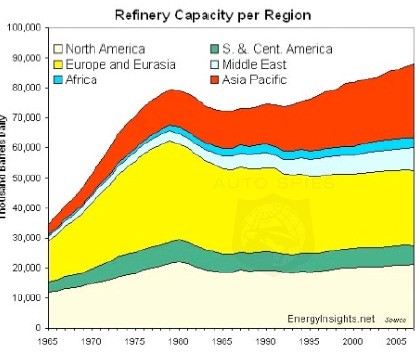
At this burn rate, it’ll take approximately 56 years before we run out of easy to get conventional oil or 278 years till we run out of oil reserves altogether. One of the common misconceptions about our consumption of oil is that we are using it at an ever increasing rate. While in reality, there was a peak in refining capacity which occurred in 1980 and most of the world and has been remarkably steady ever since. The only country defying this trend is China. To see what I mean, see the graph below.
Next, peak oil. There is another belief, that one day we will find ourselves at our maximum possible oil production level, and that when we hit this, the rigid supply and demand curves governing oil will take over along with stock speculation and oil prices will skyrocket. There are a few things however the people who formed these conclusions never took into consideration. The first is that this assumes every oil well is producing at peak production until they run out, and that we simply drill more holes to produce more oil until one day we run out of places to drill. This is a massively false assumption. Most of the oil pulled out of the ground has a maximum production cap. These caps are set by governing bodies and oil companies to maximize profits and to help regulate competition. Next, as the price of oil rises, more and more oil reserves become profitable ventures thus increasing the total supply, ventures such as oil sands, and oil shale. I doubt we will ever see a peak oil scenario. If we do see a peak oil scenario, it’ll be due solely to media hype.
Basically, we have a lot of oil, and by the time we run out, we will be on to other sources of energy, be it biofuels that supply the entire USA in 15,000 square miles (approximately 0.42% of the USA’s surface area), or be it in new nuclear/solar/wind/water/fusion technologies.
Now onto the Carbon Footprint. A lot of media hype these days is based around carbon dioxide emissions. The current worst case scenario is that increased carbon emissions results in solar rays being trapped and increasing the amount of water vapour and other greenhouse gasses in the atmosphere until a runaway scenario happens and it is too late, our planet is fried. Most reasonable people easily dismiss this worst case scenario. And the best argument against this scenario is that the carbon that we are releasing into the atmosphere now used to be in the air when the dinosaurs were around and there wasn’t a runaway greenhouse effect, so why should there be now?
But I don’t wish to argue for and or against the effects of our carbon foot print. Mainly because nobody has any solid proof that our actions are or aren’t effecting the environment in any globally profound way. Instead, I’ll simply go over what we do know.
We do know that human global emissions of carbon dioxide are approximately 8 billion tons of carbon dioxide per year. We also know that around the globe, about 3,500 billion tons of carbon dioxide already exists in the air. This means that we are putting in about 0.229% more carbon dioxide into the air every year. The big question however remains. Is this significant? If you’re pessimistic, you look at this number and are truly scared by it, after all, in 100 years we will have at least 22.9% more carbon in our atmosphere if we are able entirely successful in halting increased production of carbon emissions! That’s horrible (I think)! However, a more level headed approach would be to recognize that the planet isn’t a space ship, where every ton of emissions we release will stay in the atmosphere for eternity, since the planet was in “balance” before and we offset it from that balance. Such thinking is akin to a child believing that their parents divorced because of themselves. Science shows us that if plants are presented with higher carbon dioxide levels and/or warmer temperatures they use more carbon dioxide. If we put out emissions, the world will simply reabsorb it faster. And our crops will flourish. If you still aren't convinced, you might sleep a little better at night knowing that a carbon dioxide pipeline is being built and that carbon dioxide is being pumped back into the ground. Seriously, by pumping carbon dioxide into the ground we can pull out neighboring petroleum resources easier.
Where does this all leave us? Well, you probably should still listen to those ads telling you to turn off the tap sooner, and turn the light off when you leave the room as they have a direct impact on your wallet. But worrying about running out of gas for your car before you can no longer drive it, or the planet being doomed by all those hummers still on the road is kind of silly really.