Component Design

Component Design
As I finish up my final semester of Mechanical Engineering, I thought it would be interesting for people to see how Engineers go about Engineering cars. This article will not be an exhaustive list on what engineers do and how they do those things. I simply will introduce the concepts of idealization and finite element analysis and a bit about reverse engineering.


To guide you through the processes, I will use a connecting rod of a 3.0L Ford Duratec engine and analyze it using a program called Solidworks (Catia recently bought Solidworks, and Catia is what most of the major automotive manufacturers use).

To get an idea what this connecting rod looks like here is a picture.


http://www.autospies.com/images/users/Joe_Limon/Component-Design/connectingrods.jpg


Now, to analyze this component I required a 3D model of the component. There are a few ways to obtain/make a model. The first way is to get a hold of the original blueprints for the part. I didn't have access to Ford's vast storehouse of part drawings, so I used another method. Technical specifications of the engine and measuring the part I have. Luckily for me, I have access to a laser scanner. Using the laser scanner I was able to create this roughly accurate mesh.


http://www.autospies.com/images/users/Joe_Limon/Component-Design/cloudmesh.jpg


The original scan was about 500,000 polygons (aka made of 500,000 iddy biddy triangles). I decimated that mesh... literally, the one you see in the picture is approximately 50,000 polygons. The mesh size was reduced to help reduce the load on my computer. As you probably noticed by now, there are lots of holes in this model where I didn't get a good scan. This is ok because from here I shall use this scan as a template to trace from, and not as my actual model.


http://www.autospies.com/images/users/Joe_Limon/Component-Design/tracedmodel.jpg


Using specifications found on the ole internet, I further refined this new model. Next, by reducing the sharp angles that don't actually exist on the part I ended up with the final model of the connecting rod.


http://www.autospies.com/images/users/Joe_Limon/Component-Design/detailed%20model.jpg


Unfortunately, all these excess rounded corners do eat up memory so I will idealize the model and suppress them for now. If there appears to be any problems with my final data I can always go back and unsuppress the corners. So my final model looks like this (note that I kept the rounds on the inside diameters since they were larger and had a greater effect)


http://www.autospies.com/images/users/Joe_Limon/Component-Design/refined%20model.jpg


Now with a 3d model of the part we need to figure out what we are interested in. Do we want to analyze the fatigue? How heat is dissipated through the part? How heat expands the connecting rod around the bearing surfaces? The amount of air friction on the connecting rod? Nahhh, I'm going to do a more critical analysis, I'm going to go into detail of the stress analysis of the part to see where it will fail, and when it will fail.


Usually this is done with a process called finite element analysis (FEA). FEA is where you take a design and break it down into nodes and elements. Nodes are corner points and elements are something like sticks connecting the nodes. By applying a force to a node or a set of nodes the elements will deform. Further, if one node deforms, it will effect its neighbouring nodes and they will deform as well. The end result is that you have a tinker toy like mesh of your part. The more nodes and elements, generally the better your FEA will approximate reality.

Depending on the program you use, you can create these meshes point by point, or by use a computer algorithm to do it for you. Using the algorithm in solidworks, my first mesh of the part turned out as follows.


http://www.autospies.com/images/users/Joe_Limon/Component-Design/meshnotoptimized.JPG


Now, by applying mesh controls you can put more nodes/elements in to places you care to have more information about. For example, optimizing the mesh above yields the mesh below.


http://www.autospies.com/images/users/Joe_Limon/Component-Design/meshoptimized.JPG


Next, we need to determine the constraints on the system. First, I needed to determine the pressures acting on the piston. After running through some numbers I got the following pressure curve.


http://www.autospies.com/images/users/Joe_Limon/Component-Design/pressurecurve.jpg


This pressure curve assumes the engine is putting out 200ft-lbs of torque. At this point I will idealize my analysis again and assume that the engine puts out 200ft-lbs of torque at every engine speed when at full throttle. This is a big assumption, and has been made because it simplifies the analysis and I am only looking for general effects of the connecting rod and not specific values. If I were trying to optimize the design of the connecting rod this assumption would not have been made.

Next, I have to apply inertial loading on the component. One way to do it is to calculate the inertial force being applied to the center of gravity of the connecting rod for every time step to be analyzed and then distribute that force along one of the outside surfaces of the component. Personally I dislike this idealization and with Solidworks it's easier to not make this idealization.

First, I create a mock assembly with very simplified components.


http://www.autospies.com/images/users/Joe_Limon/Component-Design/idealizedassembly.jpg


This assembly allows Solidworks to calculate the motion of the connecting rod, and it allows me to directly apply the pressures in the pressure curve on the piston.

Now that I have all of my loads and constraints. We are ready to set up the simulation.

I'd like to analyze the connecting rod at 6000rpm, and full load. Further, I only care about half of the 4 stroke cycle, or one full revolution. I could calculate the entire cycle, but half of the cycle shows both the relative inertial loading effects and inertial effects with pressure. For this first run I went overboard, over the 0.01s revolution I got Solidworks to calculate the 350 time steps for motion analysis and 252 time steps for stress analysis. I split it between two different computers to run faster, so I hope that explains why the following printscreen gif jumps half way through the cycle.


http://img.photobucket.com/albums/v39/joe_limon/fullanim.gif


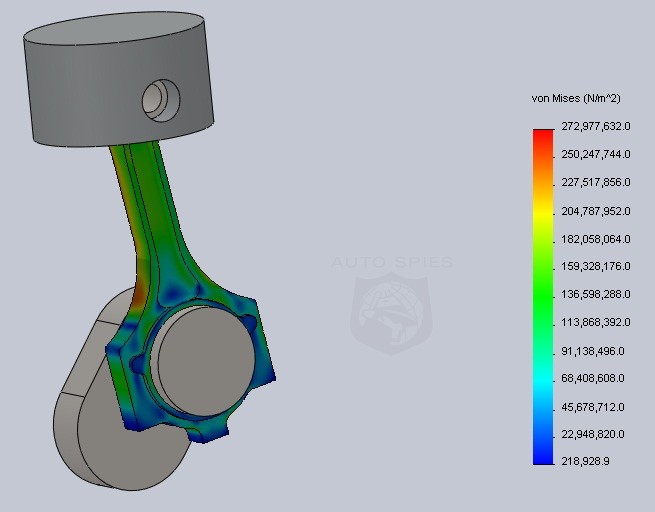
Tada! A stress animation at 6000rpm and full throttle. Furthermore, the peak stress in the connecting rod in this animation is shown in the figure below.


http://www.autospies.com/images/users/Joe_Limon/Component-Design/6000rpm.jpg


Next, lets find more data. It would be nice to know how engine speed affects the stresses in the connecting rod.

So to do that I disabled the pressure force to find out what angle the maximum inertial stress occurs. Running the simulation again with 10 times steps instead of 252, I got the following curve of maximum stresses at various angles.


http://www.autospies.com/images/users/Joe_Limon/Component-Design/inertialeffects.jpg


As you can see, the peak inertial load happens at 0 degrees/360 degrees, aka top dead center. So now we have a critical pressure angle (found in the pressure curve), and a critical inertial angle. Using both of these angles and varying the speed the maximum stresses were then found.

In the final bit of analysis I varied the crankshaft speed and comparing both the full throttle and no throttle for critical angles. No throttle in my idealization consisted of no pressure load. I realize that a 3 liter duratec is not capable of revving itself as high as shown in these graphs, but without analyzing these extremes, the graphs would have been very misleading.


Critical Pressure Graph
http://www.autospies.com/images/users/Joe_Limon/Component-Design/peakpressure.jpg


Critical Inertia Graph
http://www.autospies.com/images/users/Joe_Limon/Component-Design/topdeadcenter.jpg


A few conclusions can be drawn from these graphs.
-Inertial effects increase exponentially with increasing engine speed
-The cylinder pressure creates stress in the connecting rod at all engine speeds, and as the engine speeds up, the inertial effects of the piston and connecting rod help to counter the force.
-There is a critical engine speed that correlates to the relatively balanced system, where the effect of inertial forces cancel out the pressure force, thus minimizing the force seen on the connecting rod.
-This critical engine speed varies at different crank angles. At top dead center for this model it's about 6000rpm, however at peak pressure it's at 12000rpm.
-The lower the pressure force the lower this critical engine speed occurs at.


These are very interesting conclusions! Before this analysis, I had always assumed that increasing speed would increase the forces on all of the components in the engine. And this scenario has proven that this is not always true.

If you have any questions, ask below in the comments, or email me at joelimon(at)gmail(dot)com

P.S. This being my final semester of Mechanical Engineering, I'm looking for work internationally and I'm willing to relocate, get a hold of me at the email above if you're interested in my offer, or know of positions I could apply to :)

synxsynx - 12/3/2010 5:36:42 PM
+1 Boost
Hey, have you used ProE? If so do you prefer it over Solidworks for more complex analysis and design?


Joe_LimonJoe_Limon - 12/3/2010 6:11:21 PM
-2 Boost
Yes, I've used Pro E, in fact, that's the first solid modelling program I learned how to use. After using solidworks however, I see no advantage to using pro e, other then knowing that what I'm doing the average person wouldn't be able to do on their first try.


delandelan - 12/3/2010 6:25:29 PM
+1 Boost
Waow, I'm impressed with how far Solidworks has come. I use mostly Pro-E and I learned CATIA V4 a while back.....usually these two are the powerhouses with design and analysis packages.


sold2earlysold2early - 12/3/2010 9:20:40 PM
0 Boost
I recently switched companies, going from Solidworks to PRO/E, and it feels like I just went back in time 20 years. Some of the engineers refer to it as PRO/PAIN because of how bad the GUI is. It still gets the job done, but Solidworks kicks its butt (At least from a part and assembly modeling standpoint).

Solidworks is also much more valuable on a resume, particularly in the Northeast.


tangotango - 12/3/2010 11:47:40 PM
0 Boost
Just to prove how many morons are on this site, here we have some serious car/engineering-related talk and somebody had to go and neg rep the posters. Glad to know you're getting your schooling out of the way, Joe_Limon. It's also nice to see just how many engineering-minded folks are here as well. Keep up the good work fellas.


uaw_laxuaw_lax - 12/4/2010 3:26:07 AM
0 Boost
So tango why didn't you boost them back up? I'll take care of that. Good luck Joe stay inspired and motivated!


uaw_laxuaw_lax - 12/4/2010 3:27:32 AM
0 Boost
http://www.gm-jobs.com/go/-Engineering-Design-R&D-Jobs/155651/


Joe_LimonJoe_Limon - 12/4/2010 1:17:41 AM
-2 Boost
The most advanced math course isn't specifically a calculus course, it's an advanced boundary value course. Meaning it's an extension of both our third level calculus course and our differential equations course all in one.


delandelan - 12/5/2010 12:31:14 AM
+1 Boost
I guess times have changed....and it depends on the school. Back in the Ice age when I was in college (1996-2000) the highest math level required was Diff-Eq....and then we had the option to take an advanced level math class....Linear Algebra, Numerical methods, Discreet Math etc.


edeus123edeus123 - 12/5/2010 3:00:08 PM
+1 Boost
What up Joe? Man I'm proud of you and your accomplishments. The thing is I love the fact in which you are an actual car who happens to be M E. Lately, I find a lot of people just picking a choosing a major in which they have no passion about, and its great to see an individual devoted to his passion. If I had to do it all over again I would chose M E. I'm in business admin right now in which I came from architecture, so yeah.


edeus123edeus123 - 12/5/2010 3:44:50 PM
+1 Boost
I should had proof read what I wrote two times. Laugh out Loud. Its all good though. "an actual car" laugh out loud. Joe, You know what I met to say.I am so eager to write sometimes that I trip up on some occasions.


outsideroutsider - 12/6/2010 4:51:22 AM
+1 Boost
This article about the typical problems with current automotive engineering. Making "noise" about the technology which should be ordinary. The automotive engineers are focusing more on technology details and less on customer demands. (I knew, I'm not outsider.)
The customers fed up with the recent choice of vehicles because, the cars are:
- not reliable
- not nice looking
- extremly complicated
- heavy weight
- too expensive to buy
- too expensive to repair
- loosing value drastically (high depreciation)
- only technology, not user friendly solutions
- the car manufacturers invoicing to customers unnecessary options and technical features
- the engineers at development usually not work for money of their cars (too high salaries for low "quality" of engineering)
- the car manufacturers are using "cliché-s" in term of technologies, there are not really brake-through evolutions

And the "big" car manufacturers ar surprising, why the customers do not inted to replace their cars?


Joe_LimonJoe_Limon - 12/6/2010 10:56:17 AM
-1 Boost
Correct me if I'm wrong but... aren't cars today more reliable? The parts that do break are designed to wear out and are modular components that can be replaced with little stress.

Nice looking isn't an engineering design function. The people who design aesthetics are usually arts majors.

Complicated=more features? For ordinary people this is a benefit.

Heavy weight is due to satisfying increasing safety requirements. So it's more of a government issue.

Considering that you can buy a cheap hyundai for around $10k without all of the complicated systems you apparently dislike, I fail to see how cars these days are too expensive. In fact, isn't the average price of cars decreasing? I know it was a year or two ago.

Repair costs... are more expensive on cars with more features, if you want a cheap car to fix, buy one that's cheaper and with fewer features, the options are already available to you.

Depreciation among automobiles is not that bad when you compare it to any other industry. For example, try checking up the resale on your year old computer or tv.

Invoicing unnecessary options is not an engineering function, it's a sales person problem. And besides, you shouldn't blindly sign away any car they show you without knowing all of the options you are paying for.

Automotive Engineer Salary ranges $52,181-$82,526
For the work they do, they are not making too high of salaries.

The automotive industry is one of three main engineering pioneering disciplines. There are only two other industries that innovate as much/more. They are aerospace and for the defence industry. Both of which have far higher margins set aside for r&d. Every other industry you look in you will not see such high level pre planning for components. Do you think your blender or toaster oven uses break through technology?

Finally, car manufacturers aren't surprised that people wish to keep their cars the rest of their lives. They simply hope to entice more sales out of people and consistently get people to upgrade... Which they do.

Your frustrations with cars are not due to engineering. They are due to your own contradicting values. If you want a cheap reliable not complicated light weight car, go out and buy a $10k compact, they are on the market. You don't have to buy a mercedes or lexus.


outsideroutsider - 12/7/2010 3:19:37 AM
+3 Boost
To Joe_Limon
Current cars are not reliable than earlier ones, because they have more high risk of deffects) components. Automotive internal studies shows.
The current cars are not nice looking. If you cover the badge, you cannot find brand identities. (No artist no designers, only computer design, solidity and aerodynamics.)
The cars have more features which are absolutely useless.
The cars are heavier, which decrease drastically the active and passive safety. More weight deteriorate the drivability (dynamic inercia), braking and stability performance. At crash, the energy absorbing zones shall absorb the motion (crash) energy which linear relation with mass.
Cost of repair and maintenance does not match with options. The options shall not require maintenance cost (theoretically), they should be reliable. Your answer is typical automotive: "if you spend more your car pay more for repair".
Do not compare TV or computer with car in term of depreciation. The value and investment is totally different! Basic marketing!
Automotive industry is not one of the main engineering pioneering, most of the technologies implemented from other industrial area. (I'm working for automotive, I know!)
For the automotives the subluxury or luxury brands are making the profit. These cars need relative low cost (development, production...) and the customers are paying "extra" for brand image. Therefore every car manufacturer intend to have luxury (like) cars.
Do you think, that 50-83 k buck is low salary?
The compact cars are not reliable, not light weight. Do you think, that 2300-3000 lb. is light weight?
Summary: It is not surprising, that automotives are in the crysis. Most (all) of them pushing the problem to the customers. They think (bad attitude) the market (customers) shall change and allign their attitutes to car manufacturers. ("If you want a cheap reliable not complicated light weight car, go out and buy a $10k compact, they are on the market. You don't have to buy a mercedes or lexus.")
YOU WRONG. The car manufacturers and engineers should change their attitudes to customer demands, because the customers are paying for.
Because this kind of attitude (which written by you) the automotive (we) are in trouble. And we remain in deep until we do not change.


Joe_LimonJoe_Limon - 12/7/2010 1:48:56 PM
-2 Boost
Well... I'll respond, but I did not like how you completely disregarded a number of points and instead filled in with your own commentary. This shows a complete lack of respect.

Look at the components that are failing on the old cars, and look at the ones failing on the new cars. A fancy touch screen glitch for example does not make a car as unreliable as a leaky head gasket. Any survey over vehicle reliability that comes to the conclusions you are stating are simply weighting the above two facts equally. This means that the surveys will be biased against dependable cars with lots of features and favor old cars you see on the side of the row with no features.

Now as to aesthetics, read my point again. It is NOT an engineers job to design how a car looks. As such you do NOT see engineers sculpting with clay now do you?

Useless features... what standard features do that vast majority of buyers consider useless?

TV and computers are no different then automobiles. They are all disposable regardless of the marketing that goes into them. Cars in the 70's for example were even more disposable as they quickly rusted away on you.

What would you say is a pioneering engineering discipline? I consider automotive engineering to be one not for the engineering that goes into commodity cars, but the engineering work that goes into F1 cars and ultra luxury cars. The technology is first worked out in these two segments and by the time it is brought down to the mass commodity level it appears to be old technology. But it was still developed by automotive engineers.

50-83k is a reasonable and fair salary, it is not low, but it is definitely not as high as you claim it to be. Other engineering disciplines demand a similar salary, and in a number of cases an even greater one.

2300-3000lbs for a car that passes all current safety standards is light weight. Apparently you selectively ignored my point about the government enforced standards.

Please, show some respect if you want me to take you seriously. I have made numerous points which you have completely ignored. If you don't comment on them I have no choice but to assume you concede to them.


outsideroutsider - 12/8/2010 2:33:10 AM
+3 Boost
To Joe_Limon
Current car problems:
Oil leakage -> aluminum alloy cylindre block. However there are iron (kind) liners, the block is breathing. Serious problems, especially for turbo petrols and common-rail diesels because of the high pressure expansions in the cylinders.
Turbochargers, because lack of oil pressure. The charge pressure become higher in order to improve efficiency, required faster turbo rotation. Special treatment needed. (see owner manuals)
Catalic converters break down. Because of the save money (for better profitability) the catalic converters are tighten. Big problems with diesel particle filters. In UK there are new criminals to steal those.
Airbags needed to replace on verey 5-7 years, because the pyrotechnic actuators become older. (see owner manuals)
Headlights braked down, especially xenons. Because of the 12V standard electricity used in cars, there are high ampers in electric system in order to "serve" all electric equipent in cars. The xenon lights are too sensitive for shaking.
....

There is not technology come from F1. The F1 cars and its technologies are totally different from the standard vehicles.

The electric systems (CAN, BUS...) first usage were in the computers in early '60-s. The airflow design and the light weight (high strenght aluminium panel technologies) development were in early '20-s by aeroplane engineers. The disk brake, ABS... used in aircrafts. The turbo chargers invented for aircrafts for high altitude flying. The hybrid systems based on diesel electric locomotive technologies in early 20 century. (Ward-Leonard control, diesel-electric powered locomotives...)
The design of the vehicles made by engineers. Maybe some aesthetic element designed by industrial arts, but the technological execution made by technical engineers considering the physical requirements (airflow, safety, production and assembly technology...).
Useless features:
Onboard internet (no meaning, drive and not surfing). Digital radio (analouge is enough). Traditional air-conditioning (too heavy and sensitive. Instead of it use semiconductor A/C by seats). Sunroof. Tire repair kit.(go back to spare tyre) Xenon headlights with cornering function . (LED is cheaper and more durable...). Power windows and central door lock (more weight. This features were making for lasy people.) ...
Finally you admitted that 53-80 k is reasonable salary. Did you change your mind?
2300-3000lbs is not acceptable and not needed to pass the current safety standards. The cars could be more lighter, with less materials and revised technologies. The weight reduction can be at least 30-40%.
As far as automotive technical engineering education is, first learn at least 2 years how to repair the vehicles (from tyre change to complicated things.) After it, the students can start the study.
I know the automotive backgroudunds 18 years. There were big changes in engineering and mostly they were wrong.
There will be technical (r)evolution in car


Joe_LimonJoe_Limon - 12/8/2010 2:32:33 PM
-2 Boost
None of the issues you listed would leave you stranded on the side of the road. Therefore with new cars you can rely on them more to get you to your destination.

I listed F1 because it is automotive engineering. And because it's innovations trickle down to commodity cars. All of the features you mentioned that originated in other engineering disciplines doesn't really matter, because it was automotive engineers that took these technologies adapted them and optimized them throughout decades of research. Saying oh your variable vane turbo design doesn't show very high engineering prowess because it was first seen in a very crude form on air planes really doesn't help your argument.

The design is made by industrial designers. Engineers simply make it happen and help the industrial designers do a cost benefit analysis for the economists. In no way is it the engineer saying "the car needs to look like a box because it's the most practical shape".

As to the useless features, onboard internet you have to pay extra for. With radio stations going digital, analog is NOT good enough, who wants a radio in a vehicle that eventually won't have any station to play? Traditional air conditioning cools the air... heating and cooling seats are NOT an acceptable substitute. Air conditioning was too heavy yet the run flat tires and a tire repair kit is worth the weight? Ultra bright LED technology is not more reliable yet, I've seen my fair share of audi's with burnt out led strips. And for the extra lumens you get they are not cheaper, they are NOT the traditional led's that have been around for decades that are cheap and last forever. As to power windows and locking, that's your own personal bias, most people would turn a vehicle down if it doesn't have these two features.

Yes I fully admit that 53-80k for any engineer is a reasonable salary.

"not needed to pass the current safety standards." You must be very daft. Cars 20 or 30 years ago would not get even close to passing todays requirements. Added safety systems and heavier/stronger chassis are required to pass these tests. If you stripped all of the interior features out of a car, you would at most save 10-15% not your laughable 30-40%. And at the end of the day you would be left in a stripped down "race" car with no performance.


outsideroutsider - 12/9/2010 2:18:54 AM
+3 Boost
Sorry Joe, but your attitude is retrospective. This kind of thinking occours crysis in automotive. You think that mass saving shall be 10-15% only, but there are ready lot of new models to launch with 30% weight reduction. I saw some, and the people will surprise.
Here are some study:
http://www.autoguide.com/auto-news/2010/09/lotus-planning-bmw-megacity-rival-prototype-to-debut-at-paris-auto-show.html

http://www.4wheelsnews.com/audi-shows-its-aluminium-a5-coupe-prototype/

http://www.conceptcarz.com/vehicle/z17321/BMW-Vision-EfficientDynamics-Concept.aspx

http://www.motortrend.com/auto_news/112_0710_2007_tokyo_motor_show_toyota_concepts/index.html

http://www.autoblog.com/2009/12/02/volkswagen-up-lite-concept-at-2009-la-auto-show/

http://blogs.vw.com/conceptcars/gallery/


Joe_LimonJoe_Limon - 12/9/2010 11:42:57 AM
-2 Boost
lol lets see.

The car in the first link is a compact city car, it has smaller dimensions so of course it will weigh less. It also falls under less strict safety regulations. Although that is arguable, it's harder to reach those less strict regulations since there is less mass and crumple space to protect the driver.

The car in the second link lost 100kilos, not 30% lol! This is a perfect example of what I mean.

The efficient dynamics concept even though it has "advanced" light weight construction and a tiny engine sill weighs 3,076 lbs.

The cars in the 4th link will not pass safety laws in america

The vw in your last link is another compact car, but this one has a 800cc engine lol!

I think you entirely missed my point when I said 2300-3000lbs, I didn't mean that it's impossible to make a car in that weight category. I meant that it's impossible to take 30% of the weight out of our current cars.


Joe_LimonJoe_Limon - 12/9/2010 11:44:41 AM
-2 Boost
make a car in a lower weight category*


Copyright 2026 AutoSpies.com, LLC