Which Engine Technology Has Improved The Most Over The Last Decade
Which Engine Technology Has Improved The Most Over The Last Decade
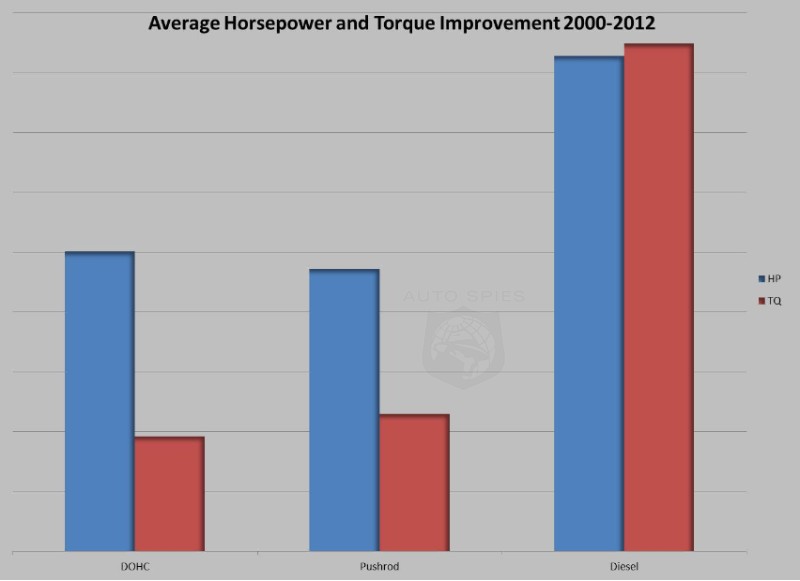
In a world with multiple competing engine technologies there are likewise multiple different metrics to statistically judge which engine technology is the best. Horsepower per liter, torque per liter, horsepower per pound of engine weight, brake specific fuel consumption, and other metrics are often brought up in discussions about various engine technologies. For now we will disregard most of those metrics and instead look to see which engine technologies have improved the most over the past decade by comparing the hp/liter and torque/liter of three different generations of DOHC, pushrod and diesel engines. Looking over the data it is easy to see that turbo diesels have made the most significant leap in horsepower and torque output since the 2000 model year. While pushrod and DOHC engines improved engine output by approximately 10% with every new generation, diesel engines on average improved their horsepower output by 16% with very new generation. The discrepancy in torque improvement turned out to be even more visible as the gasoline engine only improved their torque output by 4-5% while diesels averaged 17%.

Are you impressed with the rapid improvement of diesel technology, or are you sticking with gasoline engines for life?
Read Article

WillisWillis - 10/16/2011 8:18:57 AM
+1 Boost
All engine technologies have improved over the years.


jeffy210jeffy210 - 10/16/2011 10:59:22 AM
+5 Boost
Thank you Captain Obvious, but the question was "...the most..."


Joe_LimonJoe_Limon - 10/16/2011 11:04:04 AM
+2 Boost
This article is almost as useless as the figure it provides. The figure has no numbers on it! If you looked at the figure it looks like Diesel has improved twice as much in hp, and four times as much in torque compared to the others, yet the numbers in the article say otherwise. This is what happens when you manipulate your graph and neglect to show the corresponding numbers.

As to the article itself, what a useless metric it used. hp/liter and torque per liter? seriously? this number tells you nothing about the weight of the engine, the fuel efficiency of the engine. Not only that, it's a horrible mix of metric and imperial units! Which goes to show the kind of person who though it up, and the people who use it...


chewychewy - 10/16/2011 4:09:45 PM
+2 Boost
The diesel hp bar is about 60% taller than the DOHC and pushrod ones while the torque is 4 times taller as the article says. As the article says it will only compare the improvements in two categories for now, the others are valid as is hp/liter and tq/liter. It certainly matters for the consumer when for example the diesel engine in the Jetta made 100 horsepower in 2000 and now makes 140 in 2012 and it remained almost the same size. The units do't matter in this case as we are only looking at improvement.


Joe_LimonJoe_Limon - 10/16/2011 11:54:30 PM
0 Boost
Does the average consumer care how large of a displacement their engine is? Or do they care about how fuel efficient it is while reaching those power numbers? My guess is more toward the latter.


chewychewy - 10/17/2011 9:26:02 PM
+1 Boost
They probably don't and some probably have no idea how many cylinders or liters their engine has, but I would bet a 2 liter engine that has an equal or better hp/tq output than 3 or 4 liter engines of couple decades ago is more efficient aswell.


monstermonster - 10/16/2011 8:40:04 PM
+1 Boost
I 100% agree with Joe. If there is no numbers in those graphs then it is worthless. The tall and short bars means nothing if there is no base value to compare it with.


1c3am51c3am5 - 10/17/2011 8:44:20 AM
+1 Boost
Carburetors are much improved.


outsideroutsider - 10/17/2011 12:57:20 PM
+1 Boost
This article is missleading. The diesel technology is the most harmful one. High level of Nox and PM. The particle filters are not solution, just cracking towards the particles, still the diesels are the dirtiest.
Some manufacturer are using NOx neutralizer liquids, but it needs special treatment and it high cost. The diesels will die for passanger cars within 5-10 years.
The hybrids evolution were most impressive. Started with Toyota Prius in 1997. (Not Honda Insight). Currently te top of the hybrid evolution is the Lexus LS600h. This is a real improvement.


Copyright 2026 AutoSpies.com, LLC