The safety-related technologies that manufacturers are increasingly equipping their new vehicles with are making those vehicles more appealing to their owners, according to the J.D. Power 2015 U.S. Automotive Performance, Execution and Layout (APEAL) StudySM released today.
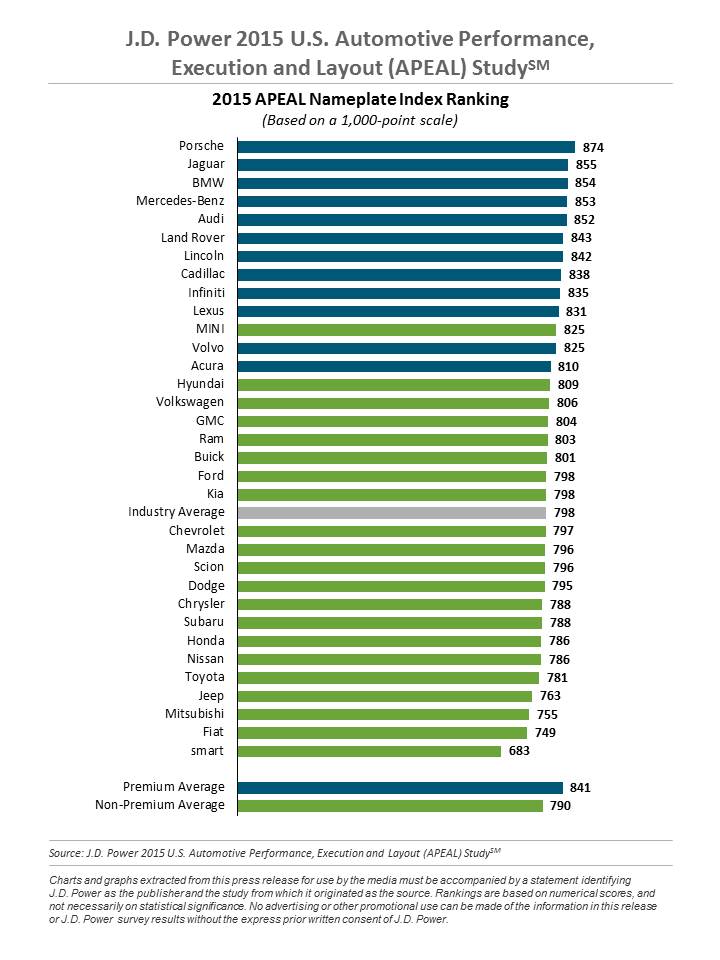
The APEAL Study, now in its 20th year, is the industry benchmark for new-vehicle appeal, examining how gratifying a new vehicle is to own and drive. Owners evaluate their vehicle across 77 attributes, which combine into an overall APEAL Index score that is measured on a 1,000-point scale. The overall APEAL score has increased by 4 points year over year to 798 in 2015.
The study finds that some safety features can contribute to a significant boost in APEAL scores. For example, the overall score among owners of vehicles with blind-spot monitoring and warning systems is 38 points higher than among those without them.
“Unlike other technologies, such as voice recognition, that can be challenging to operate, most safety features provide information in a more intuitive way, giving owners a greater sense of security,” said Renee Stephens, vice president of U.S. automotive quality at J.D. Power. “Not only are models increasingly offering systems that improve safety and visibility, but owners are also using them on a regular basis. This can go a long way toward generating positive feelings about their vehicle overall.”
The study finds that 36 percent of owners have blind-spot monitoring and warning systems in their vehicle (up 7 percentage points from 2014); 21 percent have lane-departure warning systems (up 5 percentage points); 46 percent have park assist/backup warning (up 4 percentage points); and 25 percent have collision avoidance/alert systems (up 4 percentage points).

Furthermore, 69 percent of owners who have blind-spot warning systems and 62 percent with park assist systems indicate they use them every time they drive.
Only 15 percent of owners say they have had previous experience with blind-spot warning systems, and only 39 percent say their dealer explained the feature to them upon vehicle delivery.
According to the J.D. Power 2015 U.S. Tech Choice Study,SM consumers are willing to spend substantially more on vehicles that include certain safety features. For example, respondents in that study indicate a willingness to pay a market price of $750, on average, for blind-spot detection and prevention systems.
 APEAL Gap Narrows between Premium and Non-Premium Brands
While premium brands historically perform significantly higher than non-premium brands in the APEAL Index, study findings show that the gap between the two in 2015 is the smallest it’s been in the past 10 years, narrowing by 16 percent since 2006. The average APEAL Index score in the non-premium segment (790) has improved by 5 points from 2014, while the average score in the premium segment (841) has improved by only 1 point.
“Over the past several years, we have seen non-premium brands increasingly offer the types of in-vehicle technologies that used to be available only to premium buyers,” said Stephens. “The positive impact these technologies have on owners is more pronounced among non-premium owners. In fact, owners of non-premium vehicles that include the latest technology register higher APEAL scores by 50 points, compared with just a 29-point increase among owners of premium vehicles with the same technologies.
Highest-Ranked Nameplates and Models
Porsche ranks highest in APEAL for an 11th consecutive year, with a score of 874 index points. Porsche is followed in the rankings by Jaguar (855), BMW (854), Mercedes-Benz (853) and Audi (852). MINI is the highest-ranking non-premium brand in the study with a score of 825.
The following brands receive multiple model-level APEAL awards:
Chevrolet (three): Colorado, Corvette and Sonic
Ford (three): C-Max, Expedition and F-150
Porsche (three): Cayenne, Cayman and Macan
Audi (two): A3 and Q3
BMW (two): 4 Series and 6 Series
Dodge (two): Challenger and Charger
Mazda (two): CX-5 and MAZDA6
MINI (two): Cooper and Countryman
Other models receiving awards are Fiat 500; GMC Sierra HD; Infiniti QX80; Kia Sedona; Mercedes-Benz ?S-Class; Nissan Murano; and Volkswagen Golf.
The APEAL Study is used extensively by manufacturers worldwide to help them design and develop more appealing vehicles and by consumers to help them in their purchase decisions. It complements the J.D. Power Initial Quality StudySM (IQS), which focuses on problems experienced by owners during the first 90 days of ownership. The 2015 U.S. APEAL Study is based on responses gathered between February and May 2015 from more than 84,000 purchasers and lessees of new 2015 model-year cars and light trucks who were surveyed after 90 days of ownership.