Subprime Loans Defaulting At Record Rates - Will The Next Recession Be Triggered By The Auto Industry?
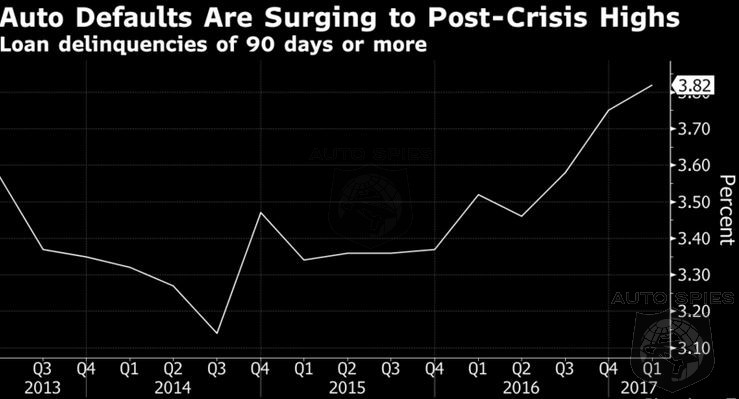
Subprime Loans Defaulting At Record Rates - Will The Next Recession Be Triggered By The Auto Industry?

It’s classic subprime: hasty loans, rapid defaults, and, at times, outright fraud.

Only this isn’t the U.S. housing market circa 2007. It’s the U.S. auto industry circa 2017.

A decade after the mortgage debacle, the financial industry has embraced another type of subprime debt: auto loans. And, like last time, the risks are spreading as they’re bundled into securities for investors worldwide.

Subprime car loans have been around for ages, and no one is suggesting they’ll unleash the next crisis. But since the Great Recession, business has exploded. In 2009, $2.5 billion of new subprime auto bonds were sold. In 2016, $26 billion were, topping average pre-crisis levels, according to Wells Fargo & Co.


Read Article

MDarringerMDarringer - 7/17/2017 11:21:02 AM
-1 Boost
Easy credit and buyer greed equals a recipe for disaster. We have customers wanting to finance their "negative equity" so they can get a new car. Sometimes what they are doing is moving their debt payment to a lower interest rate and resigning themselves to pay longer. I'm in debt (mortgages on several properties and 1 car loan) and I hate owing money. Too many people are blissfully OK being in debt.


TomMTomM - 7/17/2017 12:06:06 PM
+6 Boost
Financing is not what most consumers think it is today.
Instead of being a way for consumers to purchase a car without a single wad of cash - they are actually a profit source - in many sales the largest profit source - for a Vehicle transaction.
And when they can charge incredibly high rates compared to the prime rate - they make huge profits on the loans that actually do get paid - so much so that they figure in a fairly high rate of acceptable loan losses.

What is and will cause the next recession is the lack of progress in income acceleration for middle class jobs - which have not seen real improvement for a long time. Right now - a lot of those people are sticking their neck out and buying things because they expect a huge tax cut for low and middle income people that was promised from the current administration during the campaign. However - that will go on only so long before they realize that the regulars in the party will NEVER actually do that one.


mre30mre30 - 7/17/2017 11:31:35 AM
+1 Boost
You heard it here first - these are the things that are going to lead to recession:

(a) Strong pullback of 'foreign' money purchasing in the US Economy - from Russians and Chinese 'spending money like they stole it' on multi-million $$ homes and apartments in Luxury markets. The majority of >$25MM apartments in NYC are purchased by foreigners as "money storage" and then the ownership veiled, with the owners to never move in. Some of those have started to default and two $40MM+ units in the tony "One Fifty Seven" building are in the process of being auctioned.

(b) The trickle-down effect of (a) - impacting construction trades, building supplies, home decor, etc.

(c) Foreign money will start to pull out of the stock market, softening the stock market but hopefully not crashing it.

(d) The classic "buying things you cannot afford" - i.e. subprime car loans.

I think that the foreign money pullback will have more of an effect on the economy overall than unrealistic consumers who can't pay off their car loans. Cars produced will likely shrink over the next three years and there may be another wave of car-dealer consolidation, where banks may pull back or eliminate car dealer's floorplan loan arrangements, preventing the dealers from buying/stocking new car inventory.

The dirty secret of automotive retailing is that virtually ALL auto retailers (i.e. car dealers) finance their inventory by floor planning (i.e. financing what's on the showroom floor +) and they are then required to immediately/quickly pay back the bank when a car (the collateral) is sold to a consumer. Once car dealers get behind in paying the banks back, the floor planning lines get pulled. Dealer failures will be the canary in the coal mine.


MDarringerMDarringer - 7/17/2017 12:27:43 PM
+1 Boost
You nailed it. Mitsubishi is also skating on thin ice.


TheSteveTheSteve - 7/17/2017 11:50:41 AM
-1 Boost
When the mortgage subprime fiasco caused widespread global financial collapse, the smoking gun pointed clearly at the big financial corporations, who repackaged bad debt, misrepresented it, and sold it to investors. In response to this, the US government took mountains of borrowed money and gave it to those failed, dishonest big financial corporations, and then sent the bill to the taxpayers.

Any laws to prevent a repeat of such a fiasco have since been repealed because they were standing in the way of big financial corporations (and their owners) making huge profits, and helping millionaires and billionaires get still richer.

So here we are, setting ourselves up to repeat a similar financial collapse. Republican extremists will surely blame The Democrats for Collapse #1 and the related bailouts, while ignoring that the Republicans repealed the laws that might prevent a repeat, and they are currently at the wheel doing nothing to prevent Collapse #2. This is NOT a Democrat or Republican problem. It's a matter of government being run by the fabulously wealthy (Google Plutocracy, Oligarchy), acting in its own interests, and not on behalf of The People.


MDarringerMDarringer - 7/17/2017 12:31:35 PM
-1 Boost
Nevertheless, to overlook the fiscal idiocy of the Obama administration--which is producing the effects we are seeing now because Trump hasn't been in long enough to have had any real impact--would be ridiculous.

Similarly, pointing to scapegoats (plutocracy, oligarchy) is a pathetic attempt to shift blame.


countguycountguy - 7/17/2017 12:03:55 PM
0 Boost
Get ready for recession:part 2


280SE280SE - 7/17/2017 1:00:24 PM
+4 Boost
1) The title says defaults are "soaring" yet the chart shows that defaults have increased by only 0.70% since the low in 2014. As we come off of the recession it is only normal to see baseline default rates rise. Credit conditions were too tight in 2012-2014 and now we are merely seeing a normalization of credit availability and default conditions. The title is alarmist.

2) The fact that these loans are "bundled into bonds" for Wall Street is not in and of itself a problem. Unlike the subprime home loan bonds of yesteryear, auto lenders retain the first loss position on all of these bonds, thereby aligning them with investors. If the bonds lose, the lenders will lose too. That is a big difference versus last time. Why then are these loans bundled into bonds in the first place? It is a means for lenders to fund their lending programs, as many auto lenders are not banks and do not have deposit funding, they rely on the ability to raise money through these bonds. It is a normal and rational way for them to fund themselves, and again, they are aligned with their investors.

3) During the last housing bubble we saw people of all kinds taking out easy mortgages to buy numerous houses, mainly for the purpose of flipping the house at a profit before they paid off any principal on their home loans. These speculative borrowers don't really exist in the auto credit landscape -- No one systematically buys any mainstream car with the notion of making a profit off of it's rise in market value (classics and one-off situations excluded).

The real bubble here is likely with the Auto OEMs, who have been able to charge more than they should given this credit availability. Cars have way more options in them these days than they ever did, with gimmicky features many do not need. Auto manufacturers took advantage of the easy credit available to increase their transaction prices and keep lease and loan payments flat. If lenders pull back on credit, they don't lose, the auto manufacturers lose. Pricing will have to drop to make cars more affordable for tighter loan terms. And that is a tough pill to swallow.


280SE280SE - 7/18/2017 10:30:47 AM
+2 Boost
Runbuh, why do you only "think" that it is a 22% increase? It is a 22% increase and I cannot argue against that.

The low absolute levels of these rates render your measure a bit difficult to interpret though. In absolute terms the increase is only 0.70%, and in the context of the 15.00+% interest rates charged on these auto loans, I think that is the more relevant way to measure the increase.


Copyright 2026 AutoSpies.com, LLC