NHTSA To Investigate Why Second Tesla Crashed Into Parked Firetruck
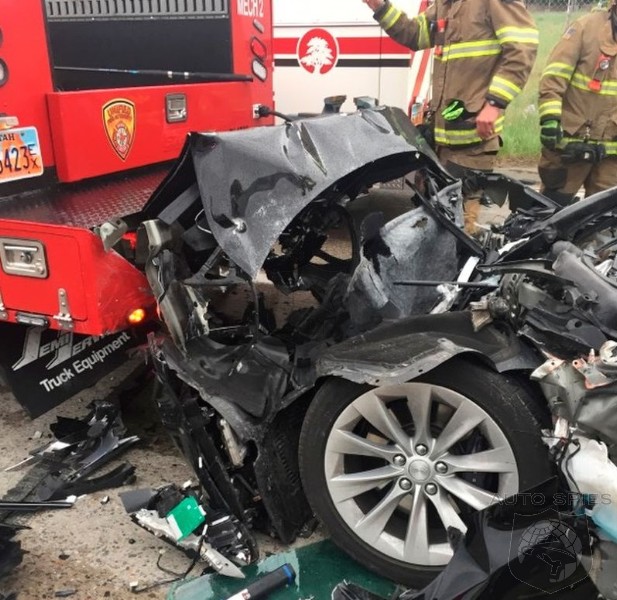
NHTSA To Investigate Why Second Tesla Crashed Into Parked Firetruck

Last Friday’s crash of a Model S in South Jordan, Utah will get the magnifying glass treatment from the National Highway Traffic Safety Administration. The agency announced Wednesday it will send a team of investigators to probe why the vehicle — which the admittedly distracted driver said was in Autopilot mode at the time of impact — collided with a stopped fire truck at 60 mph.

It’s the second NHTSA investigation of an Autopilot-related collision this year.
Read Article

TomMTomM - 5/17/2018 1:01:51 PM
0 Boost
Imagine - Tesla is so good at programming that they even included a Jealousy app!


Vette71Vette71 - 5/17/2018 1:33:14 PM
+4 Boost
Where is the automatic braking? My vehicle is so sensitive that a brakes when it spots a car exiting a highway in a lane that is too close to the travel lane. Another time when I cut into moving traffic and the car in front suddenly braked mine braked so hard everything inside came flying forward. But it stopped. The technology is out there. Why doesn't Tesla have it.


vdivvdiv - 5/17/2018 4:37:09 PM
-1 Boost
Tesla has the technology and the technology has limitations on detecting stationary objects unlike the ones given in your examples. It has to correlate what it senses with the radar and what it "sees" with the camera(s) and filter out false positives. People are not cognizant of these limitations and become complacent as the system is rather good in the vast number of cases. The problem is it only takes one time for things to go terribly wrong and when it does the statistics go out the window.


Vette71Vette71 - 5/17/2018 6:50:56 PM
+4 Boost
All of these conversations keep coming back to people have to be "paying attention", yet they apparently don't. So the system is asking humans to do something that they apparently have difficulty doing. The system needs to change, not the humans.
Also what other manufacturer has this stationary object problem? We aren't reading of other systems doing that. My vehicle has even slammed on the brakes when the car was backing up "too fast" toward a tree. Reacting to false positives is a measure of safety.


vdivvdiv - 5/18/2018 4:25:55 AM
-1 Boost
You know, paying attention is a bit of a prerequisite for driving. The question becomes as they advance if these systems tend to "free" the attention more (i.e. the system changing the driver) and put people at greater risk rather than keeping them safe. In this context it is a bit unrealistic that in addition to driving people now need to be also cognizant of the complexities and limitations of the vehicle driver assist systems as precarious as they are.

Reacting to a false positive such as an overhead highway sign that is detected by the radar as a large obstacle due to the signs high microwave reflectivity and slamming on the brakes in the middle of traffic would not be safe. Need a camera to recognize the sign as benign.

Backing your car and detecting the tree used ultrasonic sensors that have a short range 4 to 8 meters and are ineffective at highway speed due to the airflow deafening them, not just the short range.


Vette71Vette71 - 5/18/2018 9:35:54 AM
+3 Boost
vdiv you are missing my point. Its not a technical discussion about sensor technology, etc. It is simple. Other manufacturers vehicles can detect a stationary object and stop the vehicle. Tesla's cannot. Tesla has to do something different to fix the problem.


vdivvdiv - 5/19/2018 4:36:54 AM
0 Boost
That's not true, Tesla does detect stationary objects, just not in certain circumstances that are listed in the user manual. The details for those matter as this is about the sensors and getting the right response from their data since the driver did not react to the obstacle.


Copyright 2026 AutoSpies.com, LLC