
New Porsche Boxster First Details
New Boxster face
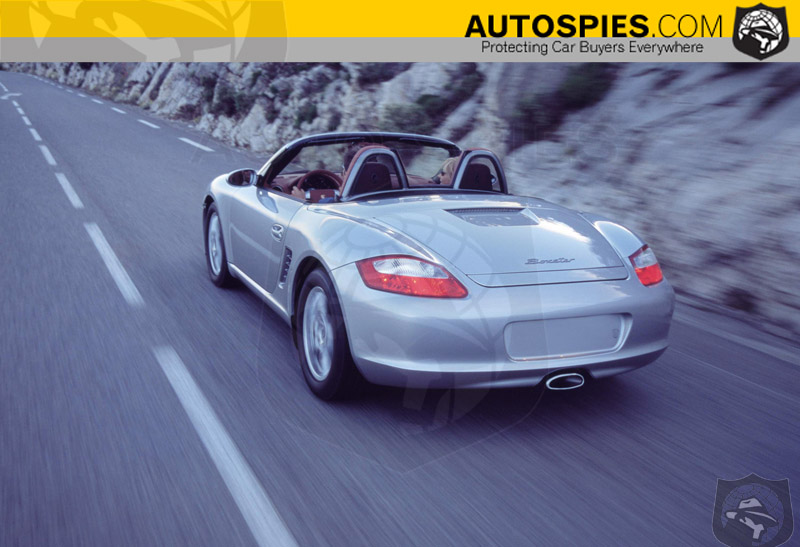
The second-generation Boxster range comes in a new dynamic outfit in terms of both looks and technical features. In their design, the new models follow Porsche's usual process of steady and consistent evolution. Without being required or seeing any need to radically change the design and looks of the car, Porsche's designers have further refined the already very well-balanced and harmonious design language of the existing model. The very face of the car with its new headlight design, the silhouette of the new Boxster with its new, even more muscular line contours, the larger wheels, as well as the rear end with its new, even more striking joints and seams all look familiar and well-acquainted, but are nevertheless even clearer, firmer and more functional in style than before. Cooperating closely with Porsche's aerodynamicists, the engineers have also succeeded in reducing the drag coefficient to just 0.29.
Even more power

The new power and strength in the design of the Porsche Boxster continues appropriately within the lightweight bodyshell of this outstanding mid-engined roadster: Maximum output of the 2.7-litre Boxster is now 176 kW or 240 bhp, an increase by 8 kW or 12 bhp. Performance on the road has improved accordingly, the Boxster now requiring a mere 6.2 seconds for the standard sprint from 0 – 100 km/h and achieving a top speed of 256 km/h or 159 mph. The optimised five-speed gearshift on the Boxster offers the driver even shorter, crisper and more precise shift travel than before, plus improved synchromesh. The Boxster is also available with Tiptronic S and a new six-speed manual gearbox in conjunction with active suspension.

Wider track with active suspension as an option
Enhanced to an even higher standard with its wider track, plus larger wheels and new tyres, the suspension allows even higher lateral acceleration with road comfort remaining unchanged. The Boxster now comes as standard on 17-inch wheels (previously 16-inch), and is available as an option ex-works with wheels measuring 18 or even 19 inches in diameter. Porsche's new Active Suspension Management (PASM) available as an option together with the six-speed manual gearbox changes the damper control map at the touch of a button, thus offering the best of two worlds in one system: The perfect combination of a sporting and comfortable suspension, on the one hand, with an extremely dynamic, performance-oriented set-up, on the other, ensuring a supreme standard also on the race track.
Sports Chrono Package for enhanced performance
The “Porsche Sports Chrono Package” is simply ideal for the sports-minded, truly dedicated driver. Offering modified engine control maps and management strategies for driving to the extreme with maximum safety and efficiency, this individual feature activated at the touch of a button comprises an analogue/digital stopwatch on the instrument panel enabling the driver to check the dynamic performance of his car down to the last hundredth of a second.
Variable rack-and-pinion steering for even greater agility
The new rack-and-pinion steering with its variable transmission ratio guarantees outstanding agility on winding roads and, at the same time, excellent driving stability at very high speeds. And now the steering wheel is adjustable not only for reach, but also for height (by 40 millimetres or 1.57"), offering the driver an even more individual seating position.
Porsche Stability Management featured as standard
“Porsche Stability Management” (PSM) featured as standard and now developed to an even higher level of perfection enhances active safety when applying the brakes, accelerating and in bends to an even higher standard of quality. The modified system allows the driver to choose an even more sporting style of motoring with even more sensitive control. The brake system has also been upgraded to match the car's even higher standard of performance, now responding even more quickly thanks to the upgraded and even more effective brake servo. Diameter of the brake discs cross-drilled and inner-vented on both models is 299 millimetres or 11.77" at the rear and 298 millimetres or 11.73" at the front.
The world's first roadster with a head airbag
The Porsche Boxster is the first roadster in the world to protect both driver and passenger against collisions from the side by means of a head airbag. Combined with a thorax airbag housed on the outer side of the seat backrest, the airbag comes out of the doorsill whenever required and ensures a very high standard of safety around the head area also in an open car. Frontal airbags for the driver and passenger, plus three-point inertia-reel seat belts with a belt latch tensioner and belt force limiter round off the restraint system featuring all these highlights as standard.
New interior with unique seats
The interior is also brand-new in design, enhanced ergonomically to an even higher standard. New materials in slush technology, in leather and in aluminium look create a very sophisticated, high-quality flair inside the car. The seats themselves are brand-new, offering the customer a choice of four different variants ranging from the standard seats through the electrically adjustable seats complete with a lumbar support and the leather sports seats all the way to the adaptive sports seats offering individual adjustment of the side supports on the seat bottom and backrest. Indeed, this range of seats is quite unique in the Boxster segment.
Enhanced range of standard equipment
Apart from “Porsche Stability Management” (PSM), an on-board computer, a CD-radio and air conditioning, the soft roof now featuring a wider range of comfort amenities also comes as standard with fully electrical operation. Within just 12 seconds, the driver can open or close the roof now also while driving at a speed of up to 50 km/h or 31 mph.
New Generation
Eight years after making its debut, the Porsche Boxster is now entering its second generation – with even more self-assertion, more power and more performance. While only carefully modelled in its contours, Porsche's mid-engined sports car is significantly wider on the road. Larger wheels and a wider track accentuate the new, further enhanced design of the body. And at the same time these improvements symbolise the increase in power, the 2.7-litre six-cylinder in the Boxster now developing maximum output of 176 kW (240 bhp), 8 kW (12 bhp) more than before. The Boxster now accelerates to 100 km/h in 6.2 seconds and has a top speed of 256 km/h or 159 mph, but is more fuel-efficient all the same, averaging 9.6 litres premium plus (29.4 mpg Imp) in the EU combined cycle. And it almost goes without saying that the Boxster outperforms the EU 4 and LEV II emission standards.
New face
The design of the new generation is full of clarity, tension and functionality. Particular highlights at the front are the new headlights, the front lights now forming separate units, the larger air intake scoops and the new contours of the front lid. With their higher, more striking topline, the front wheel arches stand out more clearly from the bootlid. The side view is characterised by larger wheels, larger air intakes in front of the rear wheels, and new, protruding door handles. The rear end remains typical of the Boxster in every respect, but now looks even more muscular with the bumper positioned higher up and the dividing seam moving up at an angle. Apart from the model designation at the rear and the newly designed, oval tailpipe, the Boxster is also characterised by its black eloxy-painted brake callipers.
Superior aerodynamics
The second-generation Boxster is even more superior in terms of aerodynamics, with the drag coefficient down from 0.31 to 0.29. At the same time Porsche's developing engineers have minimised lift forces on the front and rear axle in the interest of superior safety and stability even at very high speeds. To achieve this goal, the floor layout, the swept nose of the body and the round contours of the front end have all been optimised for superior aerodynamic efficiency and a significantly enhanced flow of cooling air. The most substantial aerodynamic modification on the new Boxster, however, is the complete underfloor cover: Enlarged by approximately 70 per cent compared with the former model, the floor cover ensures a smooth flow of air beneath the car with resistance reduced to a minimum.
Extra torque
The six-cylinder power unit of the Boxster remains largely unchanged with the exception of one significant modification: The bearing bridge on the crankshaft is now made completely of aluminium reducing engine weight by a significant 5.5 kg. Apart from its increase in maximum output, the 2.7-litre power unit offers more torque at low and medium engine speeds. Among other things, this is attributable to fundamental, ongoing development of the entire air flow system from the air filter to the exhaust tailpipe. The new, even larger filter, for example, significantly reduces counterpressure and facilitates the process of drawing in air. Another new feature is the twin-chamber distributor pipe complete with a distributor flap. The optimised air supply provided in this way means a lot more thrust from just 1500 rpm, with maximum torque of 270 Newton-metres or 199 lb-ft between 4700 and 6000 rpm. Pipes with thinner walls but a larger cross section now guide exhaust emissions directly to the silencers at the rear, reducing exhaust counterpressure in the process. Power is transmitted on the new Boxster by Porsche's revised five-speed manual gearbox. Shift operation is modified to shorten shift travel by approximately 27 per cent. The new six-speed manual gearbox of the Boxster S is available as an optional sports package together with “Porsche Active Suspension Management” (PASM). And five-speed Tiptronic S also comes as an optional extra.
Sporting suspension – as an option with active control
To enhance the Boxster's dynamic performance to an even higher level, Porsche's engineers have fundamentally upgraded the suspension set-up: Wider track, new and larger wheels combined with 17-inch tyres, weight reduction on the various components as well as enhanced torsional and flexural stiffness give the new Boxster even more sporting driving behaviour and larger safety reserves, with driving comfort remaining unchanged. Benefitting from the new generation tyres offering an even higher standard of performance, the new Boxster is able to convey a lot more power to the road: Depending on the tyres, front track is up by 24 – 35 millimetres (0.94 – 1.38"), rear track has been increased by up to 20 millimetres (0.79"). Another new feature is rack-and-pinion power steering with a variable transmission ratio combining excellent agility on winding roads with equally outstanding driving stability at very high speeds.
Apart from the “basic" suspension, the Boxster is available as an option with “Porsche Active Suspension Management” (PASM), in which case the entire car is lowered by 10 millimetres or almost 0.4". Four dampers electrically adjustable for hardness are consistently tuned to current requirements in an automatic process depending on driving dynamics and road conditions. The driver himself is able to choose from two suspension programs by pressing a button on the centre console: The “Normal mode” offers a more comfortable setting automatically becoming more dynamic as the driver chooses a more sporting style of motoring. “The Sports mode”, on the other hand, activates a harder damper control map for a particularly agile style of motoring.
Brake system with cross-drilled discs
The examplary brake system of the Porsche Boxster with brake discs now cross-drilled also on the “standard" version has been modified on two major counts: At the rear brake discs measuring 299 millimetres (11.78") in diameter ensure optimum deceleration, while the brake discs at the front are the same size as before. The wheel bearings feature black eloxy-plated monobloc swing-calliper brakes pressed against the brake linings in each case by four pistons. To reduce the forces required for operating the brakes and ensure even faster brake response, the second major improvement is an increase in the servo reinforcement effect by 18 per cent. And last but not least, the servo pressure for the brakes now comes from a mechanically driven pump, and no longer from underpressure in the intake system.
PSM featured as standard, Sports Chrono Package coming as an option
The active safety package in the new Boxster now comes as standard with upgraded “Porsche Stability Management” (PSM) comprising the well-known ABS (anti-lock brake system), ASC (anti-slip control), EDC (engine drag control), and ADB (automatic brake differential) functions. Developed to an even higher standard with even more precise control quality and optimised ABS components, these superior systems, in conjunction with the new tyres, make stopping distances even shorter.
The Boxster driver seeking an even higher standard of sporting performance in his roadster will probably go for “Porsche's Sports Chrono Package” offering an even “steeper" gas pedal control map, a harder speed limiter at maximum revs, and activation of “Porsche Stability Management” (PSM) at an even higher point. And in conjunction with “Porsche Active Suspension Management” (PASM) available as an option, the “Sports Chrono program” makes the dampers even harder and firmer in the Sports mode.
Extra space in the redesigned interior
Although the car is only slightly larger outside, the new Boxster offers more space in the completely redesigned interior thanks to the pedals moved further to the front and the lower seating position. The new seats, in turn, also offer more space and better support at the sides. In all, the Boxster is available with four different types of seats: The standard seats with electrical backrest adjustment, all-electric seats with lumbar support, leather sports seats with enhanced side support, and adaptive sports seats with individually adjustable side cushions on the seat bottom and the backrest. A choice of this kind is unique in the Boxster segment.
Use of new materials within the interior including Alcantara, leather and trims finished in aluminium-look, creates a very sophisticated flair. The three circular dials with the rev counter in the middle and black faces are now further apart in the new instrument cluster, ensuring even greater clarity, particularly with white LED illumination at night.
A power-operated soft roof is now obviously featured as standard, opening and closing at speeds of up to 50 km/h. At a speed between 10 and 50 km/h, all the driver has to do is briefly touch the roof button to open or close the roof in just 12 seconds. Other standard features include electric window lifts, a CD-radio, air conditioning with an integrated active carbon filter, an on-board computer and central locking. As an option the Boxster naturally comes with an aluminium hardtop complete with a heated rear window and a newly designed wind deflector now comprising an even larger plexiglass panel in the middle thanks to the higher rollbar. A range of new customisation features is also available, including a sports steering wheel and the multifunction steering wheel serving, for example, to operate optionally available “Porsche Communication Management” (PCM) complete with a 5.8-inch colour display, a navigation module, and a separate DVD player. Yet another innovation is the BOSE Surround Sound System with 11 loudspeakers and a high-end digital amplifier.
World-first achievement: a roadster with head airbags
The Boxster is the first open car in the world to feature a new head airbag concealed within the side panels on the doors. Together with the thorax airbags in the seat backrest, this ensures a very high standard of safety in collisions from the side. Frontal airbags for the driver and front passenger complete with a belt latch tensioner and a belt force limiter are naturally standard. The Boxster is also the leader in structural safety, its bodyshell complying with all international standards and requirements in terms of occupant and partner protection and coming with a redesigned rollbar. The so-called upper load path has been optimised in order to stiffen the passenger cell in a head-on or offset collision: The upper load path feeds forces acting on the body of the car in a collision very effectively from the front end via the doors to the rear. To ensure this effect, the doors are reinforced by an additional steel profile plate at the top and rest against an optimised side panel structure in the event of a collision. Last but not least, a support tube made of high-strength steel extending from the lower bulkhead crossbar to the A-pillar serves to further strengthen the passenger cell especially in an offset collision.
Lower cost of ownership
Cost of ownership, that is the entire cost of maintenance, fuel, insurance and road tax (without taking loss of value into account) is down in all by 13 per cent. This calculation is based on an ownership period of four years with annual mileage of 15,000 kilometres (and assumes the prices and rates applicable in Germany). The inspection and oil change intervals on the next Boxster, finally, have been extended from 20,000 to 30,000 kilometres.
Boxster S
More power, more performance
The Porsche Boxster S is entering its second generation with a lot more power and muscle: Maximum output of the 3.2-litre six-cylinder in the Boxster S is up from 191 kW (260 bhp) to 206 kW (280 bhp), ensuring a significantly higher standard of performance: The Boxster S accelerates to 100 km/h in 5.5 seconds and has a top speed of 268 km/h or 166 mph. To capitalise on this extra power, the Boxster S comes with a new six-speed manual gearbox, new multiple synchromesh and optimised gear travel ensuring not only a very precise, but also very fast gearshift (approximately 15 per cent faster than before).
More dynamic suspension, optional active dampers
Benefitting from its modified suspension, the Boxster S conveys this extra power even more effectively to the road. Larger wheels with a new generation of tyres and wider track allow an even more sporting driving experience. Wheel diameter on the Boxster S is up from 17 to 18 inches, with 19-inch wheels available as an option. An absolute highlight in the roadster segment is “Porsche Active Suspension Management” (PASM) available as an option: Simply by pressing a button, the driver can set the dampers to various positions ranging from sporting/comfortable to ultra-dynamic, in the process improving both long-distance touring comfort and the car's behaviour when driven to the limit in terms of driving dynamics.
More precision, more safety: variable rack-and-pinion steering
The new rack-and-pinion steering with a variable transmission ratio improves handling at large steering wheel angles particularly on fast, winding roads. Somewhat more indirect transmission around the central position ensures a very high standard of driving stability at high speeds, and adjustment of the steering wheel not only for reach, but also for height by 40 millimetres or almost 1.6" provides ideal conditions for a perfect position at the wheel. As an option, the Boxster S is available not just with a special sports steering wheel, but also with a multifunction steering wheel complete with integrated buttons for controlling the CD-radio fitted as standard as well as optional “Porsche Communication Management” (PCM) and the telephone system.
Driving closer to the limit with Porsche's Sports Chrono Package
Porsche has developed the “Sports Chrono Package” particularly for the driver wishing to enjoy the agile potential of the Boxster S even more to the extreme. Incorporating more dynamic engine control maps and strategies, the “Sports Chrono Package” pushes the car's limits even further. A clear sign of distinction characterising the Package is the analogue/digital stopwatch on the instrument panel enabling the driver to compare his speed to an accuracy in the range of hundredths of a second.
Brake system featuring ceramic discs for the first time
Brake discs measuring 318 millimetres (12.52") at the front and 299 millimetres (11.77") at the rear, naturally cross-drilled and inner-vented as standard, ensure supreme deceleration in the Boxster S. To further improve brake response, Porsche's development engineers have increased the transmission ratio of the brake servo by 18 per cent, helping in the process to reduce pedal forces.
The Boxster S comes as an option with “Porsche Ceramic Composite Brakes” (PCCB) featuring even larger (350 millimetres/13.78"), but lighter brake discs made of ceramics. This material is absolutely rustproof and subject to far less wear and tear on the road, while maintaining a high and, in particular, consistent frictional coefficient at all times.
Comprehensive restraint system with new head airbags
Featuring the world's first head airbags in an open car, the Boxster S sets new standards also in terms of passive safety. The airbags protect the occupants in a collision from the side by moving up instantaneously from the doorsill beneath the side window. In the process they interact with a thorax airbag on the outside of the backrest. Together with the two full-size frontal airbags, Porsche's roadster thus offers a highly effective safety system supplemented by belt latch tensioners and belt force limiters.
Sophisticated interior
The all-new interior of the Boxster S combines clear and stylish lines with a compact binnacle above the instrument cluster and the centre console further improved for even better ergonomics. Exclusively on the Boxster S, the three circular dials come with a light-grey face. The interior itself is finished in high quality materials with a special “slush" surface. The range of leather trim is even larger than on the 2.7-litre model, and additional interior features are finished in aluminium look.
Pole Position
Entering its second generation, the Boxster S once again sets a new standard: Unladen weight of 1345 kg or 2966 lb, together with maximum output of 206 kW (280 bhp), provides a power-to-weight ratio of 4.80 kg/bhp making Porsche's mid-engined roadster the No 1 performer in this discipline quite elementary to a sports car. This outstanding figure clearly proves the agility of the Boxster S in responding to the driver's commands. Taking the usual figures for acceleration and flexibility, this means acceleration to 100 km/h in 5.5 seconds continuing just as impressively at a higher speed range, with the Boxster S accelerating from 100 to 200 km/h in fifth gear in just 19.4 seconds.
Boxer engine developed to an even higher standard
This supreme performance is attributable in particular to the updated and modified 3.2-litre power unit. Operating in conjunction with optimised supply of fresh air and exhaust emission management, the modified intake system ensures extra power and pulling force at low and medium engine speeds. The first point is the significant reduction of counter-pressure ensured by the new, larger air filter facilitating the intake of air into the engine. Another new feature is the twin-chamber distributor pipe with its directly connected distributor butterfly for extra torque at low engine speeds, boosting torque substantially from just 1500 rpm. And the advantage at higher speeds is obvious, considering the maximum torque of 320 Newton-metres or 236 lb-ft between 4700 and 6000 rpm. To further optimise the flow of gas within the engine system, an exhaust manifold guides the exhaust emissions into modified, ultra-low-resistance silencers in new geometric design. The exhaust gas treatment system complete with advance and main catalytic converters, in turn, cleans exhaust emissions to a degree of purity better than the EU 4 and LEV II (USA) standards in their respective regions. The re-tuned gas cycle also has a clearly audible effect on the character and typical sound of the Boxster engine, the new six-cylinder offering an even deeper, muscular and more powerful rumble than before.
New six-speed manual gearbox
The new six-speed manual gearbox enables the driver of the new Boxster S to convert the extra power and torque of the engine even more quickly and precisely into superior performance on the road. Shift travel now 15 per cent shorter and new, high-load multi-synchromesh give the driver a truly “crisp" gearshift at all times. And as an option he also has the choice of five-speed Tiptronic S with an even more dynamic gearshift than before.
Optimised suspension for even more dynamic performance
New 18-inch wheels measuring 235/40 ZR 18 at the front and 265/40 ZR 18 at the rear, wider track and the precisely tuned suspension enhance the standard of driving pleasure in the Boxster S to an even higher level than before. Systematic reduction of weight through the use of new aluminium components on the chassis ensures an even higher standard of sporting performance and provides even greater safety reserves with motoring comfort remaining quite outstanding. This superiority comes in particular from a new generation of tyres able to convey much higher forces to the road. In combination with the wider track, the new tyres also help to reduce body sway to the side when driving to the extreme. The special handling of the Boxster S now comes out even better than before thanks to the new rack-and-pinion steering with its variable transmission ratio: When driving straight ahead, the car responds just as smoothly and forgivingly as before, even at very high speeds. And at the same time the new steering makes the Boxster S even more direct and agile under severe movements of the steering wheel, for example on a fast country road with successive bends and turns.
A unique option: the active damper system
A genuine innovation in the sports roadster segment is “Porsche Active Suspension Management” (PASM) available as an option. The basic principle of this suspension lowered by 10 millimetres or 0.4" is the continuous, automatic adjustment of the four dampers re-set electrically as a function of driving dynamics and the road surface. Pressing a button on the centre console, the driver is able to choose from two suspension programmes offered by “PASM”: The Normal mode offers a more comfortable basic setting changing automatically to an increasingly sporting mode the more dynamically the driver moves his car. The big advantage for the driver and his passenger particularly on long motorway trips is a significant improvement of driving comfort. The Sports mode, in turn, activates a harder damper control map for a much more agile style of motoring. When subject to extreme bumps and very unsmooth road surfaces, the system switches over to the more comfort-oriented setting. This not only makes the ride smoother for the driver, but also prevents the wheels from “jumping" on the road surface and thus serves to further enhance the car's high level of active safety.
Brakes with even more powerful boost
The brake system featured on the Boxster S has been further optimised to reflect the increase in engine power: Power assistance has been increased by 18 per cent in the interest of lower brake forces and an even faster brake response. The monobloc fixed-calliper brakes finished in red on the Boxster S and featuring four pistons on each wheel come with brake discs measuring 318 millimetres (12.52") in diameter at the front and 299 millimetres (11.77") in diameter at the rear.
An exclusive option: ceramic brakes
“Porsche Ceramic Composite Brakes” (PCCB) available as an option on the Boxster S open up a new dimension of brake technology in the roadster segment. With ceramic brake discs measuring 350 millimetres or 13.78" in diameter on all four wheels and with composite brake linings, this highly advanced technology interacting with yellow-painted six-piston aluminium fixed callipers on the front wheels and four-piston aluminium fixed callipers on the rear wheels ensures a high and, in particular, consistent frictional coefficient. The result is very short stopping distances even from high speeds and under heavy loads. The Boxster S comes with the latest evolution of this absolutely rust-free brake system featuring further enhanced and even more robust brake discs.
Exemplary active and passive safety
The wide range of active and passive safety features in the Boxster S comprises nearly all systems as standard. It also includes “Porsche Stability Management” (PSM) enhanced to an even higher level as well as rollbars, seat belts with belt latch tensioners, belt force limiters and six airbags. The head airbag hidden beneath the side sills on the doors is one of the most innovative and outstanding airbag systems in the world. Featured for the first time in an open car, the head airbag is activated together with the thorax airbag in a collision from the side, moving up instantaneously and inflating within milliseconds to form a kind of flat cushion.
Sports Chrono Package
The “Sports Chrono Package” featured for the first time as part of “Porsche Stability Management” (PSM) offers an optional sports mode allowing even greater wheel spin and enhanced lateral dynamics on the road. A further feature of the new “Sports Chrono Package” is the very sporting set-up of other systems within the car, including a steeper gas pedal control map and a “harder" speed governor cutting in more abruptly. The “Sports Chrono program” also allows the driver to check the dynamic benefits of this unique system down to the last hundredth of a second: The sign of distinction proudly borne out on the “Sports Chrono Package” is the activation button in the centre console as well as an analogue/digital stopwatch on the instrument panel controlled from the lever on the steering column and enabling the driver, as just one example, to time his laps on the race track with optimum precision.
New design inside and outside
The latest generation of the Boxster S is easy to recognise at very first sight: New headlights with separate light units and foglamps, larger air scoops at the front and in the sides, new rear-view mirrors with double arms, new protruding door handles, a new rear bumper and new rear light clusters are the most striking features. The newly designed twin tailpipes in the middle of the rear apron and 18-inch wheels with red-painted brake callipers now featured as standard also serve, over and above the model plate on the rear lid, to clearly distinguish the “S" model from its “basic" counterpart.
Porsche's Roadster is also all-new inside: Apart from the modified instrument cluster with three circular instruments and instrument faces finished in light grey especially on the Boxster S, the newly designed centre console ensures a sophisticated, high-quality interior. Typical features on the Boxster S are the wider range of leather and aluminium-look fittings as well as the alarm system featured as standard.
The lower seating position, the steering wheel now adjustable also for height, the pedals moved further to the front, as well as greater fore-and-aft adjustment of the seats are significant benefits particularly for the tall driver. The newly designed seats offer more space and better side support. In all, the Boxster S is available with no less than four different types of seats: Apart from the standard seats with Alcantara on the centrepiece, there are also the electrically adjustable seats complete with lumbar support, the leather sports seats with enhanced side support, and the new, adaptive sports seats with individually adjustable side elements on both the bottom and the backrest.