The new Audi A6 Avant
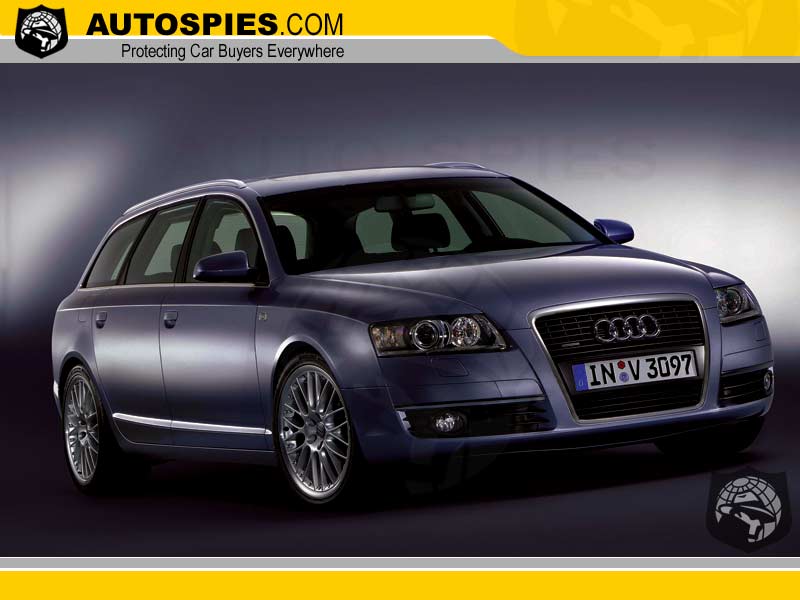
Audi is adding a new chapter to the success story of the Avant: the new Audi A6 Avant represents a unique blend of design and dynamism, driving pleasure and functionality. With countless innovations, a high standard of comfort and luxurious equipment, the Audi A6 Avant is poised to extend its lead within its competitive field.
Powerful TDI and petrol engines with up to eight cylinders and 246 kW (335 bhp) maximum output are the source of the new A6 Avant's supremacy. Front-wheel or quattro permanent four-wheel drive ensure that the engine's power is always translated reliably into traction. Power which, thanks to the advanced suspension design and very rigid bodyshell, opens up new horizons in driving dynamics.
The high quality of the materials and finish is typical of Audi interiors. A distinctively sporty flair and ergonomic perfection characterise the interior, and the driving area's architecture seems to surround and integrate the driver.
The load area of the new A6 Avant likewise radiates sophistication and innovation. An ingenious securing concept with a large number of clever configurations permits an unprecedented level of versatility and variability.
Orders for the new Audi A6 Avant can be taken from November 10, 2004.
The first cars will be delivered in March 2005.
Design
Here is a car that features notable design unity: measuring 4.93 metres in length, 1.86 metres in width, and 1.46 metres in height, the new Audi A6 Avant visibly sets a new standard. The lines of the car combine the clear architecture typical of Audi with other core elements of the brand's progressive design.
The already classic proportions of the Avant's silhouette, with its high shoulder line, narrow window area, coupé-like roofline and flat, sloping tail end, have been infused with a new degree of tension: the contours of the gently rising, curved shoulder line and the powerful, sweeping motion of the dynamic line above the side sills give the entire body of the car a forward-moving, tapered appearance.
This impression is even more dominant than on the saloon, because the basic proportions of the A6 Avant are lent that extra forward urge as a result of the rising dynamic line. The optical centre of gravity of the vehicle body is clearly forward of the rear axle, thus giving the tail end a lighter appearance.
The decidedly horizontal design of the rearward structure, with the two-section rear lights curving well in towards the centre, gives the vehicle an air of sturdiness and stability. The basic proportions and the design of the lights clearly indicate the blood ties with two other recent additions to Audi's range of five-door versions:
The A4 Avant and the A3 Sportback.
A glance at the front end, with the trapezoidal-shape single-frame radiator grille, reveals the A6 Avant to be a member of the latest generation of Audi models. The latest lighting technology is visible behind the clear glass covers of the headlights: as an option, the new A6 Avant is available with dynamic adaptive light technology incorporating high-intensity xenon plus light units and daytime running lights.
Inside the new A6 Avant, it is also obvious at first glance that this is a brand-new model generation. The high, wide centre console, for example, with controls and switches within perfect reach, emphasises the sporty interior architecture that integrates the driver as the central player.
Sporty design and perfect ergonomics – these are the features that characterise the driving area. A joint cover at the top connects the instrument cluster and the upper part of the centre console, which is turned slightly towards the driver, to form one common unit.
The instrument cluster: the round coolant temperature and fuel gauges are located inside the newly designed, teardrop-shaped surrounds, next to the two large rev counter and speedometer dials.
The A6 Avant likewise features the new generation of Audi steering wheels. As a characteristic feature of the three and four-spoke steering wheels, the single-frame trapezoid with the four Audi rings is cited on the central airbag cap. Its oval exterior geometry likewise picks up on the shape of the single-frame grille.
Versatile and sophisticated: the luggage compartment
Your luggage always travels Business Class in the new Audi A6 Avant. Inside, this is emphasised both by the materials and finish of the luggage compartment and by its entirely new securing concept. Countless meticulously thought-out details set the benchmark for this class thanks to their versatility and variability.
All new A6 Avant versions have two securing rails recessed into the floor of the level, 1.05 metre wide load area (through-loading width). These are fitted with four sliding, adjustable and lockable lashing eyes in total which, along with the luggage net fitted as standard, can be used to secure individual items of luggage of almost any size. All A6 Avant versions have bag hooks integrated into the luggage compartment trim, as well as an additional luggage net to one side. A lockable side compartment can be supplied as an optional extra, for keeping objects hidden from prying eyes.
The load area floor can be folded up as a standard feature and can be locked in a variety of positions to divide up the load area. This not only provides scope for stowing objects between the rear backrest and the raised floor to prevent them from sliding around, but also provides access to the lower load area, into which a large plastic tray is integrated.
Where can you put your muddy walking boots after a mountain hike or your wet snowboard boots at the end of a hard day on the slopes? This easy-to-clean tray provides a simple solution.
The rail system's variability can be further enhanced as an optional extra: a telescopic rod can be engaged into both rails to divide up the luggage compartment diagonally or horizontally, thus providing another means of reliably securing items of luggage. Additional support is provided by a retaining strap, which – when both ends are engaged in a rail – lashes objects down securely against the sides of the luggage compartment at the push of a button, or divides up the compartment transversely when engaged in both rails, to keep large, bulky items of luggage in place.
The cycle rack system, which has been developed specially for the A6 Avant and is likewise mounted on the rails and around the protective tray, is a means of transporting two mountain bikes securely.
Audi's development engineers have further optimised the securing method for the safety partition net, which protects the passengers against displaced items of luggage in the event of emergency braking manoeuvres or a nose-to-tail collision. It is much easier to fold the rear seat back down one third, two thirds or entirely, as desired.
The large storage box for the luggage compartment is a particularly versatile item. Secured to the rails by means of the lashing eyes, it can be arranged in two different positions: with its opening facing to the rear, it can be used for storing smaller items of luggage and for dividing up the luggage compartment. When pushed up flush against the rear seat with its opening facing forwards, the box can be accessed via the through-loading facility in the rear seat, thus being transformed into a storage compartment that is well away from inquisitive eyes.
The further-developed reversible mat (option) has exclusive velour in the interior colour on one side; on the other side, its rubberised, easy-to-clean surface protects the load area floor.
The reversible mat now also incorporates a protective sheet that can be pulled down over the bumper. This protects the bumper during loading and unloading, or provides a clean seating surface that is handy, for example when changing your footwear after a hike.
The detachable ski and snowboard bag is another new feature that will be of particular interest to winter sports enthusiasts. Winter sports equipment can be packed away swiftly and easily in the bag while outside the car, then stowed in the luggage compartment avoiding snow or meltwater drips.
For the first time on an Audi, the tailgate opens and closes automatically at the push of a button. The opening process can also be initiated by pressing the button on the car key. The required opening angle can be infinitely varied.
Engines and transmissions
The new Audi A6 Avant will be launched with a choice of no fewer than five engines installed longitudinally – three petrol and two TDI power units. All these engines share a level of power and torque that is outstanding in this segment of the market:
- 4.2 V8 developing 246 kW (335 bhp), 420 Newton-metres
- 3.2 V6 FSI developing 188 kW (255 bhp), 330 Newton-metres
- 2.4 V6 developing 130 kW (177 bhp), 230 Newton-metres
- 3.0 V6 TDI developing 165 kW (225 bhp), 450 Newton-metres
- 2.7 V6 TDI developing 132 kW (180 bhp), 380 Newton-metres
All engines comply with the limits of the EU4 emission standard. A diesel particulate filter can in addition be ordered as an option for the TDI engines.
The six and eight-cylinder power units come from Audi's new V-engine family. Their highlights in design and construction are the 90° cylinder angle and a distance of 90 millimetres between the cylinders, compact dimensions, maintenance-free camshaft drive via a chain and low-friction roller-arm valve drive.
The 2.7 V6 TDI
In addition to the 3.0 TDI, the A6 Avant is starting out with a further representative of the latest V6 TDI engine generation with common rail system and piezo inline injectors: the 2.7 TDI.
Like its big brother, which has a capacity of three litres, it makes use of the latest injection technology and consequently already undercuts the demanding EU4 emission limits, which will not take effect until 2006, even without a diesel particulate filter.
A new crankshaft with the stroke reduced by 8.3 millimetres, new connecting rods and different pistons result in an overall swept volume of 2,698 cm3. This engine’s key performance data are a power output of 132 kW (180 bhp) in a speed range of between 3,300 and 4,250 rpm and a peak torque of 380 Nm which is available from 1,400 rpm and remains at this high level all the way up to
3,300 rpm.
The result is a spontaneous response and tremendous pulling power even from the lowest revs. The 100 km/h mark is passed after just 8.3 seconds on the way up to a top speed of 225 km/h. But it is the mid-range sprints that are the outstanding discipline of this new high-performance engine.
The pioneering common rail injection system with piezo inline injectors permits up to five separate amounts of fuel to be injected per working cycle, at an injection pressure of 1600 bar. Piezo technology enables considerably smaller and more precisely metered injection quantities. At the same time, the system responds twice as fast as conventional solenoid-valve injectors thanks to the higher speed of the injector needle. This effect is particularly important in maintaining brief intervals and high precision between the separate multiple injection processes, of which there may be up to five.
The fuel is injected into the combustion chamber via eight-hole nozzles. In conjunction with the combustion chamber recess, this results in excellent fuel preparation and consequently in particularly efficient combustion.
These measures result not only in high performance and an enormous torque plateau, but also in low fuel consumption (7.0 litres per 100 kilometres), extremely low emissions and outstanding acoustics. It is especially in this latter area that the new engine undoubtedly represents the new benchmark in this class.
Driving dynamics and ride comfort
A gain in torsional rigidity of up to 25 percent: this advance compared with the bodyshell of the predecessor version – in itself widely praised as very robust – is reflected in the new model's vibrational comfort, road behaviour and interior acoustics.
The rigidity of the steel bodyshell is itself the result of methodically enhanced joining technologies plus optimised panel profiles. The improve¬d vibrational behaviour moreover lays the foundations for the harmonious but nevertheless sporty tuning of the chassis. In conjunction with the direct, extremely stable link connecting the steering column to the module subframe, this body configuration is the basic prerequisite for the precise handling of the A6 Avant.
The Audi dynamic suspension layout as featured on the new A6 Avant is based on proven sports technology: the refined four-link front suspension acknowledged as a typical Audi feature and the self-tracking trapezoidal-link rear suspension carried over from the Audi A8 – a combination used on both the front-wheel-drive and quattro models.
The result is a standard of dynamic driving behaviour that is beyond compare, plus ease of control far superior to the competition. This is also due in no small measure to the speed-dependent servotronic power steering featured as standard, supplementing the precise handling of the new A6 Avant with even more sensitive steering precision.
Click here to view part two