THE ALL-NEW 2006 MERCEDES-BENZ R-CLASS
INTRODUCTION
The R-Class is an entirely new type of Mercedes-Benz, representing the 12th model line in the brand’s broad portfolio. The R-Class is the first vehicle from Mercedes to combine the distinct advantages of several disparate vehicles – the sure-footedness of a four-wheel-drive sport utility vehicle, the versatility of a luxury wagon and the performance of a fine sports sedan. Manufacturer’s Suggested Retail Pricing (MSRP) for the 2006 R-Class will begin a $48,000 for the V6-powered R350 and $55,500 for the 302-horsepower V8 R500 (plus a $775 destination fee for both models).
A New Type of Mercedes-Benz
The new R-Class is a vehicle that simply wasn’t possible a few years ago. Innovative technology and out-of-the-box design now make possible an automotive decathlete – a vehicle that can excel at an unprecedented range of owner needs. With its vast experience as an innovator – bringing new thinking to new segments as well as designing and building luxury wagons, sedans and sport utilities – Mercedes-Benz is ideally positioned to produce such a new type of versatile vehicle like the R-Class.
Three Rows of Luxury
With a sharp focus on design, comfort, space and performance, the new R-Class is designed as a roomy vehicle with space for six adults – three pairs of comfortable single seats in a spacious interior, with individual seats in both rear rows that can each be folded down.
The new R-Class is five inches longer than a Cadillac Escalade and 10 inches longer than an SRX, giving it the commanding size that U.S. customers want. In comparison to other Mercedes-Benz models, the R-Class is about an inch longer than the flagship S-Class sedan. Around 64% of the vehicle's overall length is available for the occupants, proportions that conventional sedans just can’t match.
As an indicator of comfort and roominess, the R-Class boasts about 34 inches between the 1st and 2nd rows, and each 2nd-row seat can be adjusted fore and aft about six inches, increasing the seat spacing to as much as 39 inches. There’s more than 30 inches between the 2nd and 3rd rows, giving the vehicle class-leading 3rd-row leg room.
The second-row seats resemble captain’s chairs, and the layout provides a convenient walk-through to the third row. An optional second-row center console houses more cupholders, for a total of eight, plus four door-pocket bottle holders.
Dual-Screen, Dual-Source Rear Entertainment System
The second-row center console can also hold an optional dual-source rear-seat entertainment system. Two separate inputs allow one occupant to watch a movie on one screen, while another passenger can be playing a game or watching another DVD on the second screen.
A Functional Form
The new R-Class scores an aerodynamic drag rating of 0.31 Cd, an impressively low figure that’s competitive with the sleekest luxury wagons. Its low wind resistance contributes to good fuel economy and low interior noise.
Four-Wheel-Drive, Seven-Speed V6 or V8 Power
Featuring the R350 and R500 models, the R-Class line will go on sale in the U.S. later this year. All Mercedes-Benz R-Class vehicles will come with a seven-speed automatic transmission and full-time 4MATIC four-wheel drive. Optional equipment such as four-wheel electronic air suspension with ADS adaptive damping and an AMG sport package will also be available.
Mercedes-Benz Safety
Continuing the Mercedes-Benz commitment to occupant safety, the 2006 R-Class comes standard with two-stage adaptive air bags for the driver and front passenger, window curtain air bags that span all three seating rows and belt tensioners and belt force limiters. A rollover sensor can deploy the belt tensioners and the curtain air bags if the vehicle senses an imminent rollover.
EXTERIOR DESIGN
Back to the Future
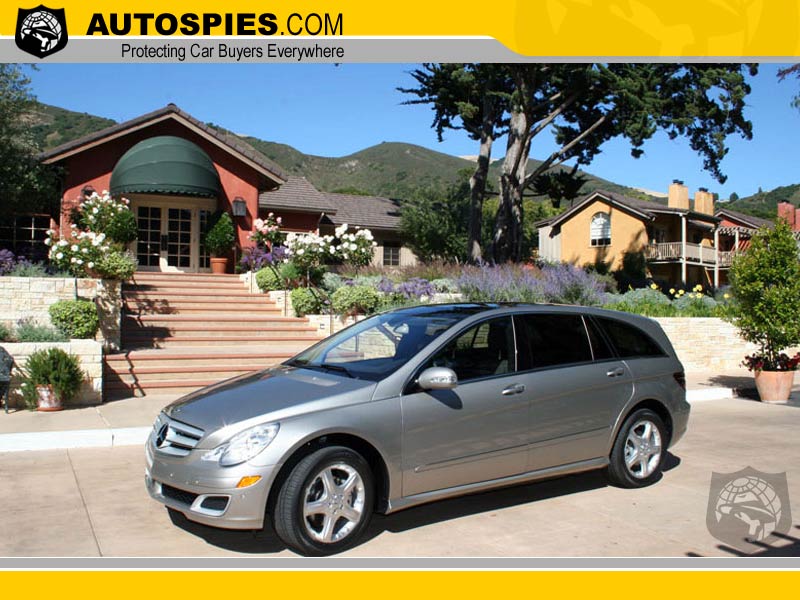
The exterior styling of the all-new R-Class is elegantly futuristic -- a long, sloping profile with an eye-catching accent line along the sides of the body to the rear lights. At the same time, the sleek shape is vaguely reminiscent of channeled and lowered custom cars of the 1950s and ‘60s, especially around the rear roof pillars.
Is it a wagon? A sport utility? A traditional body style isn’t immediately obvious. The R-Class exhibits the grace of a fine sports sedan, the proportions of a luxury wagon and the go-anywhere presence and seating position of a four-wheel-drive SUV.
The surface of the front hood is a few inches above the fenders, defining the nose of the vehicle and creating a strong line between the roof pillars and front bumper. A short grill sports the Mercedes star logo amid three horizontal bars. The front windshield is so steeply raked (61.5°) that it seems to extend the line of the front hood.
Projector Beams Light the Way
The front-end styling is accentuated by eye-catching elliptical headlights that slope sharply toward the rear and come to a point at the trailing edge. Triangular parking lights are nestled between the main beams and the grille.
Projector-beam lights are standard, and optional Bi-Xenon curve-illuminating headlights combined with corner-illuminating front fog lights provide enhanced visibility. These swiveling headlights follow the steering input of the driver to rapidly pivot to the relevant side when the car enters a bend, improving road illumination by up to 90 percent over fixed lights in turns.
When the driver activates the turn signal or turns the steering wheel (below 25 mph), corner illuminating fog lights light up areas of the road that would remain dark with conventional lighting systems – areas that could include a pedestrian or cyclist.
INTERIOR DESIGN
Rich, Sporty, Attention to Detail
The interior of the new R-Class features an impressive sense of room and spaciousness. A four-spoke multifunction steering wheel with brushed aluminum accents on the lower spokes greets the driver, and behind the steering wheel is a new electronic gear selector mounted on the steering column to control the standard seven-speed automatic transmission.
The upper section of the two-tone dashboard arches over the instrument cluster, which is dominated by two eye-catching cylindrical binnacles that are angled slightly inwards. The gauge cluster holds the speedometer and tachometer with an inset clock and fuel gauge.
Nestled between the two large chronograph-style gauges is a central display as well as readouts for gear selection and outside temperature. Accessed by multi-function buttons on the steering wheel, the central display can control the audio system, the optional navigation system or integrated phone, and allows the driver to customize a number of settings ranging from mile/kilometer readings to how long the lights stay on after the car is turned off.
User-Friendly Space
A clearly arranged center console features easily accessible and well-positioned ergonomic controls and displays, as well as two large cupholders that can hold two 32-oz. cups or one 44-oz. cup. Located just below the two central air vents is a second-generation modular COMMAND display that integrates the audio system, navigation and optional telephone controls. The standard audio system includes AM-FM-weather band radio, a single CD slot and controls for optional satellite radio.
Located below the display are the dual-zone climate controls. The system features nine sensors and regulates cabin temperature by mixing heated and cooled air, modulating fan speed and varying the displacement of the air conditioner compressor. The system can also vary the amount of recirculated air, for example, to cool down the car on a hot day. A pollutant sensor can also automatically switch to the recirculation mode if it senses high CO or nitrogen oxides in the fresh air inlet.
Second-row passengers have their own control panel that can adjust air distribution to each second-row seat via vents in the rear of the center console, on the B-pillars and under the front seats.
An optional three-zone climate control system features 12 sensors, two blowers and separate temperature controls for the driver, front passenger and 2nd-row occupants. This system also provides additional air vents in the side panels for the 3rd-row.
The optional climate control system comes with IR laminated glass that features a transparent metallic coating in the glass. Applied to the windshield and front side windows, the coating reflects 80 percent of the sun’s infrared light.
An armrest between the front seats conceals a large split-level storage compartment, in which the upper level can house the optional integrated phone. The driver’s door panel incorporate incorporates power window controls, outside mirror adjustment and liftgate release.
Families who are busy with sports and recreational activities will appreciate the versatility of the R-Class.
All three seating rows are finished with high-quality materials, while the contrasting colors and textures of the interior are repeated on the transmission tunnel and door panels, which are accented by burl walnut and aluminum trim.
It’s a Concert Hall, Too
The standard audio system uses eight speakers, and an optional surround-sound system features eleven speakers, including an extra sub-woofer. A six-disc CD changer in the glove box includes an auxiliary plug that allows MP3 devices to be played through the car’s audio system, and an optional kit allows most iPod units to connect to the car as well.
iPod titles and play lists appear in the COMAND and dash displays. Both standard and optional audio systems include a speed-sensitive volume control. To compensate for background noise, the audio volume is automatically increased as road speed increases. In addition, an antenna diversity function selects the strongest signal from two different FM antennas imbedded in the rear window.
Entertainment options include satellite radio as well as standard AM and FM radio. Separate audio plugs allow front occupants to listen to one source, while 2nd-row passengers can listen to a separate source.
Create Your Own Environment
The R-Class allows each occupant to create their own sense of space with standard features such as individual reading lights, armrests, air vents and cupholders as well as seat adjustments for each seat and separate-source audio plugs. This individualization is further enhanced with the optional iPod integration kit and dual-screen video entertainment system.
And, everybody has a window seat. The front row of the new R-Class can be compared to first-class seating, with business-class seating in the second and third rows.
Add the optional panoramic sunroof, and the overall sense of interior space in the new R-Class is unprecedented.
R350 V6 Engine
The new R-Class is available with a choice of two powerplants that define two distinct models. The R350 is powered by a new-generation 3.5-liter twin-cam V6 engine that produces 268 horsepower, while the R500 comes with a single-cam 5.0-liter V8 that makes 302 hp.
Variable Valve Timing
On the 3.5-liter V6, variable intake and exhaust valve timing requires separate camshafts for the intake and exhaust valves, so the new powerplant (first used in the 2005-model SLK350) represents the first time Mercedes-Benz has used double-overhead camshaft technology on its V6 engines. Valve timing can be automatically adjusted within a range of 40 degrees using electro-hydraulic vane-type adjusters.
At part throttle, the valve timing adjuster keeps the exhaust valves open as the intake valves are opening, using this valve overlap for internal exhaust gas recirculation, reducing exhaust emissions and improving fuel economy. However, approaching full throttle, the camshaft adjustment optimizes valve timing for maximum power.
To minimize interfering with air flow through the ports, valve stems are only six millimeters or about ¼ inch in diameter (most valves have 8 or 10 mm stems), and the valves are angled at 28.5 degrees to optimize the combustion chamber shape.
Improved Fuel Efficiency, More Power
The 3.5-liter aluminum V6 produces 268 horsepower and 258 foot-pounds of torque, with maximum torque available from 2,400 rpm all the way up to 5,000 rpm. In fact, at just 1,500 rpm the new V6 develops 87 percent of its maximum torque! While the variable valve timing system gets a lot of credit for the engine’s unusually broad torque curve, a two-stage intake manifold plays a key role as well.
Two-Stage Intake Manifold Fattens the Torque Curve
The intake manifold is made of a lightweight magnesium alloy. At relatively low engine speeds, a set of flaps in the manifold close off short intake passages, forcing intake air to take a much longer route into the engine. This creates pressure waves that help the intake process and improve torque at lower engine speeds. Above about 3,500 rpm, the flaps open, and intake air flows the shortest distance to the combustion chambers, helping to generate maximum horsepower, especially at higher speeds.
Tumble Flaps Improve Fuel Efficiency
The R350 engine is equipped with newly developed tumble flaps in the intake passages near the combustion chamber. The tumble flaps pivot open under partial load, improving combustion by literally making the air tumble, creating additional turbulence around the intake valve and in the combustion chamber.
During higher engine loads such as full throttle, the tumble flaps are completely recessed in the wall of the intake manifold. Better combustion helps improve engine torque, but the primary purpose of the tumble flaps is to further increase fuel economy, and tests show that the tumble flaps indeed boost fuel mileage by about two percent.
Assembling the New Engine from Start to Finish
First, a forged steel crankshaft with four main bearings is placed into an aluminum engine block that features wide main-bearing saddles and transverse bearing supports that minimize vibration. A balance shaft is then installed in the block between the two cylinder banks, about where the camshaft is located on a pushrod-type “V” engine.
The balance shaft is driven from the crankshaft by a long double chain that loops around one camshaft in each cylinder head and engages the underside of the balance shaft sprocket. This means the balance shaft counter-rotates at crankshaft speed, and its “lobes” help cancel out the inherent imbalance and vibration of a 90-degree V6
Iron-coated aluminum pistons are pinned onto forged steel connecting rods that are about 20 percent lighter than on comparable engines. The pistons slide into the cylinders, and the connecting rods are clamped around the crankshaft journals.
When the aluminum engine block is pressure-cast around silicon-aluminum cylinder sleeves, its bores are etched to make a long-life, low-friction running surface for the piston rings.
The two cylinder heads are bolted onto the block, and twin camshafts are installed in each cylinder head. The intake camshafts are driven by a double chain, and gears on the intake cams drive the exhaust camshafts.
Even Downstream Emission Controls are Elegant
Double-wall exhaust piping is used to keep the exhaust air as hot as possible leading to twin catalytic converters located just below the engine. With the help of secondary air injection, the catalysts promote downstream conversion of pollutants into carbon dioxide and water vapor, and two oxygen sensors for each catalyst monitor and help manage the entire process.
R500 V8 Engine
The R500 engine is a 5.0-liter 90-degree V8 with a single overhead camshaft in each cylinder bank. This engine architecture features twin spark plugs and three valves per cylinder – two intakes and one large exhaust valve.
Three-Valve Technology
Three-valve-per-cylinder technology can reduce exhaust emissions, especially during the critical warm-up stage. Catalysts must heat up to work effectively, and modern engines must heat up quickly.
In the 5.0-liter V8, combustion heat in each of the large, single exhaust valves is dissipated through a sodium-filled valve stem, while exhaust heat is retained and insulated by double-wall piping in the exhaust manifold. The seamless double-wall manifold is made by using high-pressure liquid-forming technology for greater durability and lighter weight.
Spark Plugs Provide a One-Two Punch
Using one less exhaust valve also makes room for two spark plugs per cylinder, and an innovative offset-phase twin-plug ignition system is matched to the three-valve technology. Among other things, the dual ignition system activates the two spark plugs in each cylinder, one after the other in quick succession (rather than simultaneously), with varied “stagger,” depending on engine load and speed. This phase-shifted twin-plug sequence (as well as the basic ignition timing) changes after each combustion cycle for extremely precise control of the combustion process. This also enables combustion chamber pressures to be closely controlled to minimize combustion noise without sacrificing efficiency.
Low-Friction Silicon-Aluminum Cylinder Sleeves
Mercedes-Benz was the world’s first automaker to use innovative cast-in silicon-aluminum cylinder sleeves with a low-friction surface that allows piston-ring spring tension to be reduced by 50 percent.
Thanks to a number of such friction-reducing measures, internal “drag” is 45 percent lower than other engines. The efficiency payoff for low internal friction means both fuel savings and increased power. Now used in most Mercedes-Benz engines, this sleeve technology is also designed to provide exceptional block stiffness while minimizing weight. The sleeves are more than a pound lighter than conventional iron sleeves, which makes for extremely lightweight components.
The Long and the Short of It
The R-Class engine features extremely long intake pipes, a plus which provides outstanding low- and mid-range power. Cast into the super-lightweight magnesium intake manifold are long spiral intake passages, and incorporated into the manifold are flaps (one for each cylinder) that are closed below about 3,500 rpm, forcing intake air to take a relatively long route through the manifold and build up pressure waves, which boost the intake process and improve low- and mid-range torque. At higher speeds, the flaps open, allowing intake air to take a shortcut — a more direct route to the cylinders — for maximum high-speed power and efficiency. The electronic engine control unit determines precisely when the flaps are open and closed
Modern Modular Assembly
The ability to manufacture six- and eight-cylinder engines under the same roof provides for increased output, which further reduces costs. As a result, a full range of V6 and V8 engines – all with a standard distance between cylinders of 106 millimeters or 4.2 inches – is produced at the engine plant in the Stuttgart suburb of Bad Cannstatt.
TRANSMISSION
The World’s First Seven-Speed Automatic
The new R-Class comes with the world’s first production seven-speed automatic transmission. When compared to other transmission designs, the seven-speed makes the vehicle faster and more economical while providing smooth, barely noticeable gearshifts.
Seven gear ratios provide a wider spread of ratios between first gear and top gear and, at the same time, allow smaller increases in engine speed as the vehicle accelerates through the gears. This gives the electronic control unit more flexibility in terms of maximizing fuel economy and making the transmission’s reaction time extremely fast.
Skip a Gear When You Need To
Unlike most transmissions, the seven-speed transmission will skip up to three gear ratios if necessary when it downshifts, shifting directly from seventh to fifth, for example, or even sixth to second. This helps the transmission choose the perfect gear ratio for quick acceleration and ensure smooth, almost imperceptible shifts in the process.
Lock It Up for Better Fuel Mileage
The Mercedes-Benz seven-speed uses a refined, proven hydrodynamic torque converter with a special lock-up clutch inside the converter for maximum fuel efficiency. The lockup clutch eliminates the usual torque converter “slippage,” providing the direct connection and fuel efficiency of a manual transmission when the lockup clutch is engaged.
In the seven-speed, the lockup clutch engages in all seven gears. (To put that into perspective, many cars lock up the converter only in top gear.) The Mercedes-Benz lock-up clutch is submerged in transmission oil and uses special long-life friction materials.
Where’s the Shifter?
Unlike most vehicles, the look of the center console of the new R-Class is not dominated by a shift lever. Thanks to the latest electronic control technology, a small stalk on the right side of the steering column now serves the purpose.
Select Direct shift control is simpler than ever. Lift the stalk up for reverse, push down for drive, and push a button on the end for park. Once underway, pushing either one of the manual shift buttons on the “back” of the steering wheel provides Touch Shift forward gear changes.
While all Mercedes automatics feature Touch Shift, the new layout on the R-Class further improves its usability. As on all Touch Shift cars, it isn’t necessary to move the shift lever to another gate to make manual gear changes – in fact, the selector lever positions for forward gears are gone. Though gears can be manually selected, computer control prevents downshifts that would cause the engine to overrev.
Full-Time Four-Wheel Drive
Like the M-Class, the R-Class features full-time all-wheel-drive with three conventional “open” differentials in the front, rear and center of its powertrain. The center differential allows the front wheels to go faster than the rear when turning, while the more traditional front and rear diffs permit the outside wheels to go faster than the inside ones in turns.
Four-Wheel Traction Control
The Mercedes-Benz R-Class stands apart from many other all-wheel-drive vehicles by using a four-wheel adaptation of the company’s proven electronic traction control to maintain stability and traction on wet or snowy roads. The system senses wheel slip electronically and brakes the slipping wheels, which enables the differentials to naturally transfer torque to those tires with more grip.
Unlike many conventional all-wheel-drive systems, the Mercedes-Benz system automatically provides mobility even when three wheels lose traction. Handling is enhanced, and in tight steering situations, there is no axle “binding,” which the driver would experience as sluggish steering response and vibration.
50-50 Center Differential
The center differential is located in a transfer case, along with a link chain which turns a prop shaft to the front differential. Under ideal road and driving conditions, torque distribution is 50 percent front / 50 percent rear. In slippery road conditions, the benefit of full-time all-wheel-drive is obvious. The system can vary torque transfer front-to-rear and side-to-side to be directed to the wheels with traction. In practice, all available torque can even be transferred to one wheel. Yet, even on perfectly dry highways, the system helps give the R-Class more secure handling.
Body
Unit Body Platform
The new R-Class features a self-supporting unit body with high torsional rigidity. As a result, the new R-Class boasts impressive comfort, resistance to vibration and excellent handling stability, with a robust floor, sidewalls and roof frame that also provide stable attachments for the rear liftgate. The roof pillars are formed of three layers of steel, which are connected to the reinforced side members.
High-Strength Alloy
While conventional steel dominates the materials mix, 62 percent of the new R-Class body panels are formed from high-strength steel. Some of these alloys, in particular “dual-phase” steel, even fall into the very high strength category. The two-phase microstructure of this alloy can withstand very high loads and, as a result, contributes to the strength of the passenger cell.
Low-Stress Welding
The flanges on many of its steel panels are designed so that any tolerances are already compensated for when the sheets are positioned, which allow them to be welded together with less metal stress. This technique also contributes to corrosion protection because it eliminates most of the extra brazed and MAG welding seams, which can be vulnerable to corrosion.
Fully Galvanized Body Panels
Every body panel in the new R-Class is zinc-galvanized and organically coated on both sides. The coating also contains rust-preventing zinc pigments.
Many structural areas of the body receive cavity protection, and welding seams are carefully sealed. A six-section plastic undercladding provides protection against stones, water and dirt, eliminating the need for any conventional PVC undercoating. Substantial wheel well cladding (1/8-inch thick) also helps protect against stones and gravel.
Aerodynamic Details
A sleek body shape and a host of other measures earn the new R-Class an impressive aerodynamic drag coefficient of 0.31. This abstract number provides real-world benefits such as good fuel economy, low interior noise and exemplary handling stability.
Small spoilers in front of the wheels, a special diffuser in the rear apron and smooth underbody panels are among the aero touches that also contribute to low lift and high stability. In addition, the optional air suspension system further optimizes stability and reduces drag by more than three percent when it lowers ride height at speed.
Double and Triple Door Seals
To minimize wind noise and vibration at speed, special measures were taken to contour the A-pillars, and inner and outer panels of each door form a vibration-resistant unit and that the integral window frames are especially sturdy.
In addition, a double seal is used around the entire circumference of each door, and a triple seal is even used in some areas, in part to keep the door sills free of dirt.
The windshield is 0.2 inches (5 mm) thick, and the side windows are 0.15 (3.8 mm) in thickness, also to help keep wind noise out of the passenger compartment.
Even the windshield wipers were developed in the wind tunnel – they feature a one-piece rubber section with integral leaf springs that ensure even pressure across the entire windshield. Dispensing with the usual multi-joint claw system makes the R-Class wipers less prone to icing and cuts wiper height by nearly half, reducing wind noise in the process.
Two Different Sun Roofs
The new R-Class is available with two different optional sunroofs that can both tilt or retract – a conventional glass panel and a double-sized panoramic sunroof featuring a glass panel that’s 5’ 7” in length that provides an even greater sense of space. When opening, one half of the panel moves on top of the other so headroom isn’t reduced. Electrically operated roller blinds on the inside of the panoramic sliding roof protect occupants from the sun.
Both sunroof designs include an air deflector to minimize wind noise inside the vehicle. The air deflector for the panoramic roof automatically retracts about ½ inch (12 mm) when airflow reaches a certain level, reducing wind noise and buffeting on the highway.
Chassis
Four-Wheel Independent Suspension
The R-Class features independent front and rear suspension. Four-wheel independent suspension endows the R-Class with sports-car-like handling and stability as well as the ride comfort and low noise levels of a luxury vehicle.
Double Wishbone Front Suspension
The R-Class front suspension features newly developed upper and lower control arms in a double-wishbone configuration. The upper arms are mounted very high in the chassis and are made of high-strength, light-weight forged aluminum, which further reduces unsprung weight, while the lower control arms and steering knuckle are cast iron. The front suspension uses coil spring struts with single-tube gas shocks and large head bearings, and a stabilizer bar attaches to the lower control arms.
A front subframe is attached to the unit body by four large rubber bushings. The sheet steel subframe carries the engine, transmission, rack and pinion steering gear and the lower control arms, while the upper control arms and shock/spring units connect directly to the R-Class body. The front differential housing is attached by three large noise-insulating rubber mounts.
Four-Link Rear Suspension
Similar to the front, the rear suspension is mounted to a subframe that is isolated from the body by two solid rubber bushings and two hydro mounts that are filled with a liquid that helps to dampen vibration.
Mercedes engineers have developed a new four-link rear suspension for the R Class that consists of the following parts:
• Forged steel upper rods
• Sheet steel camber arms
• Cast iron lower wishbones
• Tubular steel track rods
Separate shock absorbers are positioned behind the coil springs, and a stabilizer bar completes the picture.
Rack-And-Pinion Steering
The Mercedes R-Class employs a rack-and-pinion steering unit that’s mounted ahead of the front wheel center. The hydraulically assisted steering has a variable ratio that operates more directly, or slightly faster, in the center position.
In addition, the new R-Class steering is available with a speed-sensitive feature. An electronic valve ensures full power assist at low speeds for easy parking and low-speed turns, and the valve reduces the amount of power assist at higher speeds for improved road feel through the steering.
Serious Brakes
The new R350 comes with large 13-inch (330 mm) vented front and solid rear disc brakes. The R500 is equipped with larger 13.8-inch (350 mm) vented front discs, with 13-inch vented discs at the rear. Because of the natural transfer of weight to the front of the vehicle during braking, both models have twin-piston brake calipers up front and single-piston calipers at the rear.
Wheels and Tires
The R350 comes with 17-inch light-alloy wheels shod with 235/65 R 17 tires, while the R500 has 18-inch wheels and 255 / 55 R 18 tires. Both models are available with 19-inch wheels and 255 / 50 R 19 tires as part of the optional Appearance package and AMG Sport package.
Height-Adjustable Air Suspension
Developed by Mercedes-Benz, optional AIRMATIC air suspension not only improves R-Class ride comfort, but also provides impressive flexibility by allowing for reduced ride height on the highway and increased ground clearance over rutted roads or deep snow, maintaining vehicle level when loaded and continuously adjusting the suspension damping as road conditions change. The driver can also select three different levels of damping.
Above 77 mph, the AIRMATIC system automatically lowers ride height more than ½ inch (15 mm) for improved handling and stability, as well as about 3 percent less air drag and, as a result, better fuel mileage. When speed falls below 25 mph, the suspension returns to normal height.
On rough road, a rocker switch on the dash allows the AIRMATIC system to raise vehicle height by more than three inches (80 mm), so that ground clearance is increased. The system automatically returns the vehicle to normal ride height at speeds above 25 mph.
Adaptive Damping System
AIRMATIC air suspension includes an adaptive damping system that can actually change compression and rebound damping every 0.05 second in response to changing road conditions. If the system senses small body movements, it maintains a comfort mode with relatively soft damping.
With more body movement, the system uses solenoid valves in the shocks to cycle automatically between hard rebound and hard compression modes.
A rocker switch on the dash can lock the suspension into a “sport” mode – hard rebound and hard compression. The switch has three positions, which also allows it to lock in the comfort mode or maintain automatic operation. In summary:
• Stage 1 – the “comfort” setting, with soft compression and rebound damping
• Stage 2 – soft rebound and hard compression damping
• Stage 3 – hard rebound and soft compression damping
• Stage 4 – the “sport” setting, with hard rebound and compression damping
The AIRMATIC system features air bladders instead of coil springs, and ADS gas shock/air spring struts are used in the front of the R-Class. In the rear, ADS gas shocks are located behind the air springs.
Mercedes-Benz Innovations Abound
The new R-Class chassis comes with a number of Mercedes-Benz innovations that have been embraced by most of the auto industry:
• ABS anti-lock brakes for better directional control during braking, especially on slippery or uneven surfaces
• ESP stability control, which senses skids, then reacts in a split second to help restore control – government studies have proven that ESP can reduce single-vehicle accidents by up to 67 percent!
• Brake Assist, which ensures full-power braking in emergency stops
Some additional Mercedes innovations are detailed in the following Safety chapter.
Safety
Crumple-Zone Body Design
Mercedes-Benz safety engineers have designed the unit body platform of the new R-Class to take advantage of the latest occupant safety technology. Half of the body structure is formed from high-strength or very-high-strength steel alloys. Two longitudinal members of high-strength steel with reinforcing cross members, a front cross member and two more longitudinal members above the wheel wells are key energy-absorbing features of the new front end.
Two crash boxes of high-strength steel bolted to the longitudinal members are designed to absorb most of the impact energy in low-speed frontal collisions. As a result, the crash boxes and a number of other bolt-on components can be replaced less expensively without welding.
At higher speeds, the longitudinal members form a key part of the crumple zone that absorbs more impact energy. In an offset frontal collision, an aluminum bulkhead and several cross members are designed to help spread the forces across the entire front end. Longitudinal members above the wheel wells serve as a second level of energy absorption in offset frontal collisions.
A high-strength steel subframe that carries the engine, transmission, steering and front suspension is also designed for controlled deformation in a severe frontal collision, and even the wheels play a role. Supported by the strong side walls, the wheels help absorb some of the crash forces.
A High-Strength Passenger Cell
While the front and rear of the new R-Class are designed to deform and absorb crash energy, the reinforced passenger cell protects its passengers by maintaining occupant space.
The floor, roof pillars, longitudinal members and side walls frame this rigid compartment. The transmission tunnel is formed of thick steel and serves as the backbone of the floor structure. Transverse cross members connect to the tunnel and provide high lateral strength in a side impact, as well as a solid mounting point for the seats. In addition, diagonal members extend from the front bulkhead to the B-pillars to further strengthen the floor.
External side panels and multi-piece interior side panels help to shape and strengthen the roof pillars, roof frame and side members. As an aside, sound-absorbing foam contributes to impressively low noise in the new R-Class, and 34 such foam sections are incorporated just in the two side walls.
Rear Crumple Zones, Too
The rear longitudinal members of the new R-Class are made of continuous closed box sections with tapered thickness for low weight and maximum strength in a rear collision. The fuel tank is located in a protected area in front of the rear wheels.
Like the front, the rear also features bolt-on steel crash boxes and an aluminum cross-member that absorb impact energy in low-speed collisions, which can be replaced in a relatively simple and lower-cost procedure.
Seat Belts, Belt Tensioners and Belt-Force Limiters
The new R-Class is fitted with three-point, inertia-reel seat belts for all six seating positions, as well as electronically controlled belt tensioners and belt-force limiters. In a collision that exceeds the deployment threshold, the tensioners take up seat belt slack to increase its effectiveness by allowing restraining contact between the belt and occupant earlier in the collision sequence.
Later in the sequence, belt force limiters can somewhat limit the restraining force of the seat belt against the occupant, reducing the risk of chest and shoulder injuries.
Two-Stage Front Air Bags
Two-stage front air bags for the driver and front passenger feature two inflation rates, depending on the severity of impact and other factors such as the weight category of the front seat occupant. For example, if sensors initially detect a front-end impact that exceeds the activation threshold for an average occupant, one chamber of the gas generator is deployed. As the crash sequence progresses and a more serious frontal collision is sensed, a second chamber is deployed 5 to 15 milliseconds later to increase the inflation rate of the air bag.
Side Impact Protection
The new R-Class is equipped with standard window curtain air bags that span all three rows of seats. In a side collision, the window curtain air bags can help cushion front and rear occupants on the impact side of the vehicle when their heads move toward the side windows or roof pillars. In addition, the air-filled cushion can block glass splinters that could cause injury in a side impact or rollover. Over nine feet long, 14 inches in height and about two inches thick when inflated, a window curtain air bag on each side of the car can deploy in about 25 milliseconds from the ceiling and extends across both front and rear side windows.
Severe and often fatal head injuries that might occur in side collisions are usually due to either an occupant’s head striking the interior or the whiplash movement of the head. With respect to side impacts above the system threshold, crash tests with the window curtain air bag indicate a 90 percent reduction in the forces likely to cause head injuries. The new R-Class also comes with door-mounted side air bags for the front seats that protect the torso and work in conjunction with window curtain air bags.
A Highly Advanced Sensor System
A highly advanced sensor system gives the restraint system excellent reflexes. Two sensors in the nose of the R-Class (on the radiator cross member) provide initial collision data, and can deploy the belt tensioners before the primary sensor in the cabin could react. These upfront sensors can also provide data to the system’s central processing unit earlier in the collision sequence, helping it determine whether or not both stages of the front air bags should deploy.
Satellite sensors in the lateral cross members under the seats work together with the central crash sensor to deploy the side air bags in the event of an actual collision that exceeds the deployment threshold.
Sensors in the front passenger seat are used to determine the passenger’s weight category, and the inflation rate of the air bag deployment is varied accordingly.
Rollover Sensor
The new R-Class is also equipped with a rollover sensor, which can recognize this type of accident and relay the information to the central control. If the sensor detects a rollover, the control unit activates the belt tensioners and curtain air bags.
Tire Pressure Monitoring
Mercedes-Benz innovations such as ABS anti-lock brakes, ASR traction control ESP stability control and Brake Assist are standard on all Mercedes passenger vehicles. However, the new R-Class also has another feature that makes clever use of existing wheel speed sensors for ABS and ESP.
Since an under-inflated tire is smaller and rolls slightly faster to keep up with the other three, the system uses wheel speed signals to identify under-inflated tires and alert the driver. In effect, the ESP system not only helps to keep the car safely on course but now also keeps an eye out for any significant loss of tire pressure.
Equipment
R350 Standard Equipment
Performance
All-new unit body design
3.5-liter DOHC V6 engine with 268 horsepower and 258 lbs./ft. torque
Driver-adaptive electronically controlled seven-speed automatic transmission
Full-time four-wheel-drive with 4-Wheel Electronic Traction System (4ETS)
4-wheel independent suspension
4-wheel 13-inch disc brakes with 4-channel Anti-Lock Braking System (ABS)
17-inch seven-spoke aluminum alloy wheels
235 / 65 R17 mud and snow radial tires
Safety and Security
Safety cell and crumple zone body
Driver and passenger two-stage adaptive front air bags
Door-mounted side air bags in front
Window curtain air bags for all three rows of seats
Tire pressure monitoring system
Rain-sensing windshield wipers
Central locking system
Automatic anti-theft alarm
Illuminated entry system
Exterior
Halogen headlamps with high-impact polycarbonate lenses
Dual heated power side-view mirrors
Rear-window defroster
Single-lift tailgate/door
Rear wiper
Privacy glass
Interior
Leather-wrapped multi-function steering wheel
Leather seat inserts (with MB-Tex bolsters)
Brown birds-eye maple wood trim on doors, dash and center console
Second-generation modular COMAND system
4-speaker, 80-Watt audio system with AM/FM/Weatherband CD stereo, auxiliary plug for MP3 devices and integrated controls for optional CD changer
Factory pre-wiring for optional CD changer, satellite radio and integrated cellular telephone
Power windows on front and rear doors with express down and up (on door panel)
Power front seats
Easy fold-down 2nd and 3rd row seats
Dual-zone air conditioning with dust filter and rear blower
Cruise control
Full instrumentation including speedometer, tachometer, fuel and coolant temperature gauges, electronic digital odometer, resettable trip odometer and quartz clock
Three-button Homelink garage door opener
Delayed-shutoff front courtesy lamps
Four reading lights
Rear seat and cargo-area courtesy lights
Illuminated visor vanity mirrors
Front center armrest with two-level storage
Two 32-ounce front console cupholders
Dual rear cupholders in 2nd and 3rd rows
Storage pockets in dash, doors and front of console
Four bottle holders in door pockets
Retractable cargo cover
Additional R500 Standard Equipment
302-horsepower 5.0-liter SOHC V8 Engine
Larger brakes
18-inch five-spoke wheels with 255 / 55 tires
Heated Seats
Memory system for seat and mirror position
Silver grille with chrome ribs
Chrome door handles, tailgate trim and side molding
Electrically adjustable steering column
Burl walnut interior trim
Six-disc CD changer with MP3 capability
Parameter speed-sensitive power steering
Blue-tinted sport glass
Tele Aid
Options
Appearance Package (includes Alcantara interior and 19-inch wheels)
AMG Sport Package with 19-inch wheels (details TBD)
Height-Adjustable AIRMATIC Air Suspension (with ADS Active Damping System)
Bi-Xenon Curve Illuminating Headlights (with corner illuminating front fog lights)
harman/kardon Logic 7 audio system with six disc CD changer (in glove box)
Three-Zone AC (includes rear temp zone)
Cargo Management System
Rear Seat Entertainment System
Power Glass Sunroof
Power Panoramic Sunroof w/pop-out rear-quarter windows
Keyless-Go
Parktronic
Satellite Radio
Power Liftgate
DVD Navigation
Multi-Contour Seat
Heated Front Seats
Heated 2nd Row Seats
Auto-Dimming Mirrors
Wood-Leather Steering Wheel