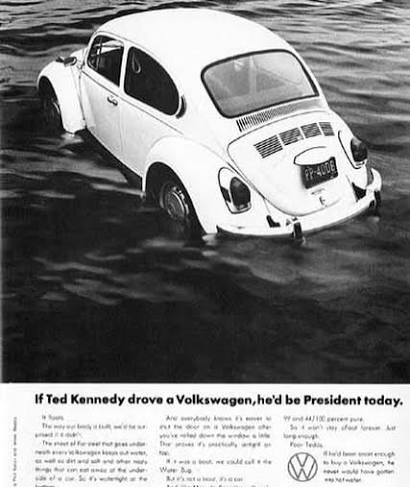
In the fall of 1973, readers flipping through the pages of National Lampoon’s Encyclopedia of Humor encountered what appeared to be a genuine Volkswagen advertisement. A Volkswagen Beetle was shown floating serenely in water up to its hubcaps. The bold headline read: “If Ted Kennedy drove a Volkswagen, he’d be President today.” The copy cleverly parodied Volkswagen’s real advertising campaign touting the Beetle’s airtight, watertight construction — a feature that supposedly allowed the car to float. In this satirical version, that same quality would have saved Mary Jo Kopechne’s life during the infamous 1969 Chappaquiddick incident.
The ad was pitch-perfect in mimicking the clean, minimalist style of Doyle Dane Bernbach’s legendary VW campaigns. Many readers didn’t immediately recognize it as satire. Outraged customers flooded Volkswagen of America with angry letters, believing the company had produced the tasteless ad itself. One wrote, “I will be damned if I will buy another Volkswagen after seeing an ad like the attached.” The piece referenced the Chappaquiddick tragedy with brutal directness. On July 18, 1969, Senator Edward “Ted” Kennedy drove his Oldsmobile off a bridge on Chappaquiddick Island, Massachusetts. Kennedy escaped the submerged vehicle and swam to safety, but his passenger, 28-year-old Mary Jo Kopechne, drowned. The scandal derailed Kennedy’s presidential ambitions and became a symbol of privilege and alleged cover-up in American politics.
National Lampoon’s fake ad turned that pain into dark comedy, suggesting that Volkswagen’s engineering superiority could have changed history. It was the kind of boundary-pushing humor that defined the magazine during its golden era, when it blended sharp political satire with adolescent irreverence.Volkswagen was not amused. The company filed a $30 million lawsuit against National Lampoon, alleging trademark infringement, copyright violation, and defamation. The legal pressure worked. On October 29, 1973, the two parties reached a settlement. The magazine agreed to recall unsold copies of the publication, remove the offending cartoon from future editions, and issue a formal apology. The incident highlighted the power — and risk — of parody in an era before the internet made misinformation and satire blur even more easily. What looked like a real print ad fooled many precisely because it was so well executed. Decades later, the “floating Beetle” ad remains one of the most notorious examples of satirical advertising gone corporate. It proved that even car companies, famous for clever marketing, could be targets when humor cut too close to real tragedy.